
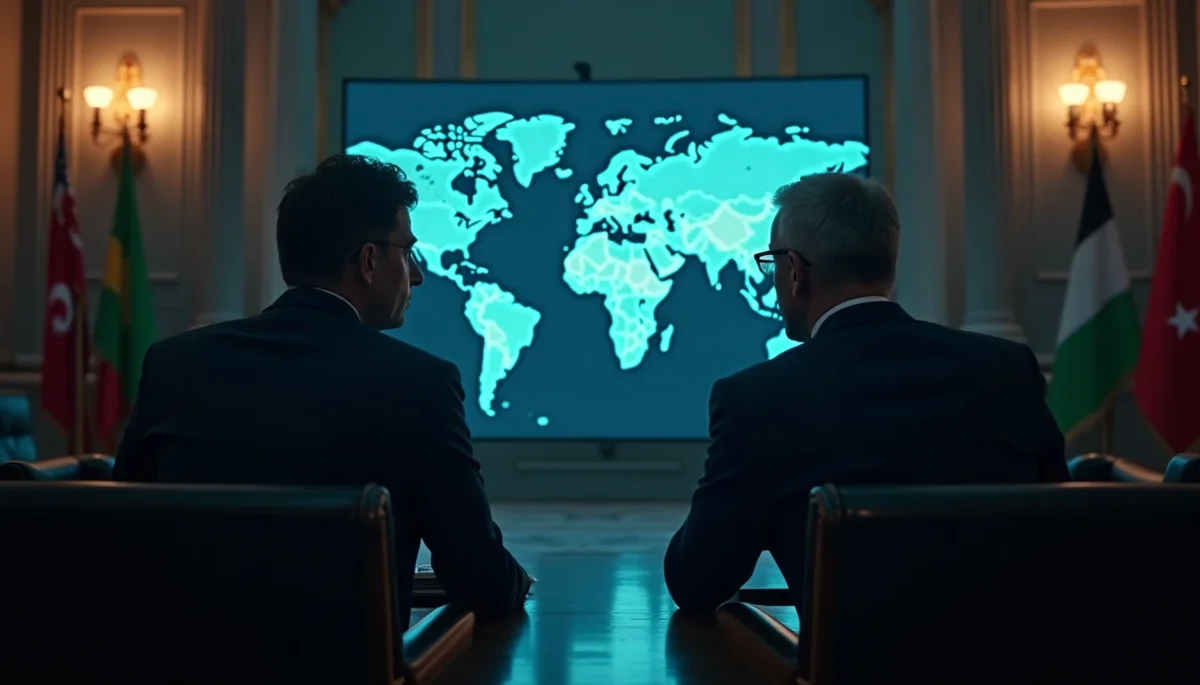
Christmas Eve 2025 arrives with a striking paradox: nations that once championed free expression now wage open warfare over who controls the digital public square, even as traditional geopolitical fault lines in the Middle East undergo rapid, unexpected shifts.
The transatlantic alliance fractured publicly this week when Secretary of State Marco Rubio announced visa bans against five European activists, including a former EU commissioner, who have worked to combat antisemitic disinformation online. President Emmanuel Macron condemned the move as an attempt to undermine European digital sovereignty, while EU officials accused Washington of 'coercion and intimidation.' The irony cuts deep: the sanctioned individuals were targeting hate speech and disinformation, yet the Trump administration frames their work as censorship of American tech platforms. This clash exposes a fundamental divergence in how Western democracies now define freedom itself.
The digital sovereignty battle extends far beyond diplomatic spats. Governments across the collective West are now turning their sights on VPNs—virtual private networks that millions use to protect their online privacy. Denmark has emerged as a testing ground for restrictions that would have seemed unthinkable a decade ago. Meanwhile, Australia's leaders are crushing online free speech under the banner of protecting multiculturalism, even as radical Islamist threats continue to plague the nation. The surveillance infrastructure expanding globally represents what analysts at Off-Guardian describe as 'The Great Reset in motion'—a coordinated restructuring of society where pandemic responses, inflation, and energy crises serve as pretexts for unprecedented control mechanisms.
In California, a U.S. District Court delivered a significant ruling on parental rights, blocking schools from hiding information about students' gender identity from parents. The decision affirms fundamental constitutional rights at a moment when the boundaries between state authority and family autonomy remain fiercely contested. These cultural flashpoints—from gender policy to speech codes—reveal societies struggling to maintain coherence amid rapid technological and social transformation.
The Middle East presents its own tableau of realignment. Russia is quietly mediating between Israel and Syria's new leadership, marking Moscow's return to regional influence even as its forces remain bogged down in Ukraine. Britain, Canada, Germany, and other nations condemned Israel's approval of 19 new settlements in the occupied West Bank, calling it a violation of international law—yet their protests carry diminishing weight as traditional alliance structures fray. In Turkey, President Erdoğan's media mouthpiece Yeni Şafak declared Israel 'threat number one,' reflecting conspiracy theories gaining mainstream traction across Turkish security establishments.
The IDF confirmed that a Lebanese soldier killed in a recent strike had documented Hezbollah connections, underscoring how deeply the terror organization has penetrated Lebanon's state institutions. Prime Minister Netanyahu, speaking at an Air Force graduation ceremony, issued a veiled warning to Iran: 'We're not seeking conflict, but our eyes are open.' The statement comes as regional powers assess whether Tehran's axis of resistance—weakened but not destroyed—will attempt reconstitution in 2025.
Perhaps most symbolically, Palestinian extremists torched a Christmas tree outside the Holy Redeemer Church in Jenin last week. The tree had stood briefly as a public symbol of the small Christian community's presence amid growing lawlessness. Its deliberate destruction sends an unmistakable message about the precarious position of ancient Christian communities across the region—communities that have celebrated Christmas in these lands since the faith's earliest centuries.
The prophet Daniel spoke of a time when 'knowledge shall increase' and 'many shall run to and fro.' What we witness today—the explosion of digital surveillance, the fracturing of alliances over information control, the rapid realignment of powers in lands central to biblical prophecy—suggests we are living through precisely such an acceleration. As 2025 draws to a close, the question is not whether these systems of control will expand, but whether any space for genuine human freedom will remain within them.