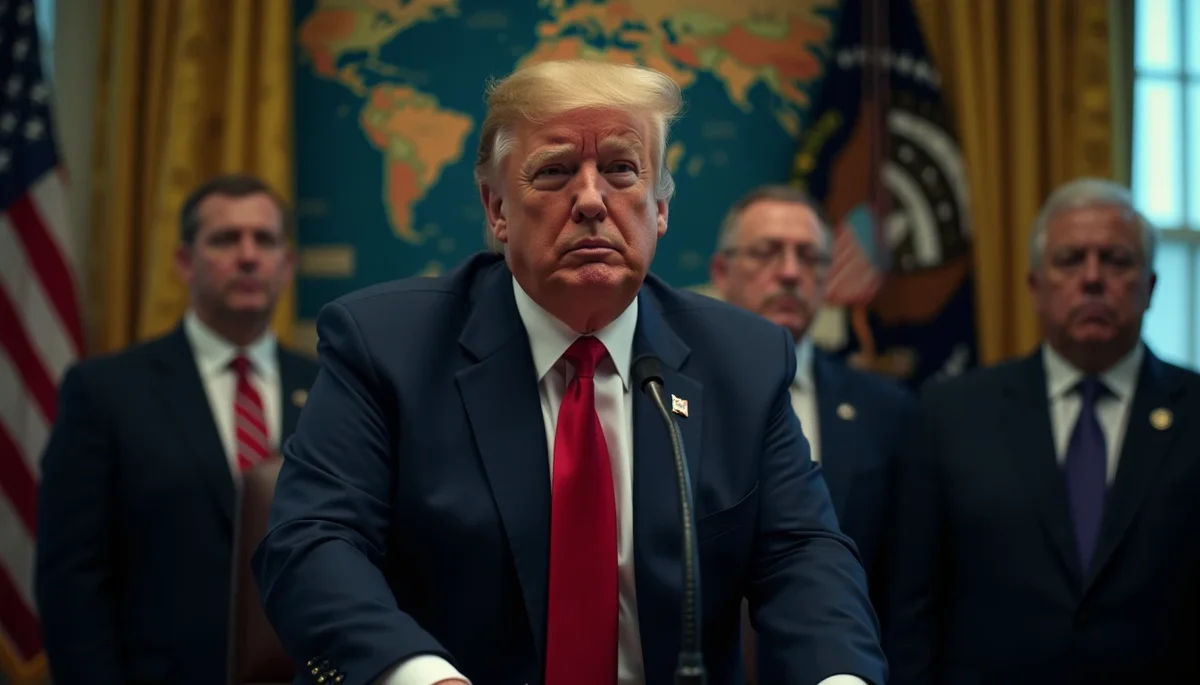
President Donald Trump issued his most direct threat to Tehran yet on Friday, warning that the United States stands 'locked and loaded' to intervene if Iranian authorities begin killing peaceful protesters. The unprecedented statement marks the first time a sitting U.S. president has explicitly promised direct intervention on behalf of Iranian demonstrators, writing on social media that Washington 'will come to their rescue.' The warning arrives as unrest continues spreading across Iranian provinces, with the regime facing its most sustained challenge since the 2022 protests.
The escalating rhetoric toward Iran unfolds against a backdrop of intensifying regional pressure. Eight nations—including Qatar, Egypt, Jordan, Saudi Arabia, the UAE, Turkey, Pakistan, and Indonesia—issued a joint statement demanding Israel allow 'immediate, full, and unhindered' humanitarian deliveries to Gaza, where nearly 1.9 million displaced Palestinians face deteriorating conditions amid winter storms. Meanwhile, Israeli officials are weighing expanded operations in Lebanon as intelligence suggests Hezbollah is rebuilding its capabilities despite the ceasefire agreement. Prime Minister Netanyahu reportedly discussed potential strikes with Trump, though U.S. officials are urging patience to allow diplomatic efforts with Beirut to continue.
As geopolitical tensions mount, a parallel battle over information control is reshaping the digital landscape across multiple continents. Europe is laying groundwork for what critics call climate science censorship, with a new report encouraging broader restrictions on debate that deviates from official narratives. South Korea's new law targeting deepfakes and disinformation has drawn sharp criticism from the incoming U.S. administration, which accuses nations pursuing such digital regulation of censorship. The Foundation for Individual Rights and Expression reports that campus censorship in America reached record levels in 2025, marking a troubling milestone in the fight over free expression in higher education.
The infrastructure enabling such control continues expanding rapidly. Hong Kong launched a sandbox for its corporate identity program CorpID while connecting e-government services with Shanghai. Moldova's Digital National Farmers Register is scaling nationwide with EU backing, part of a broader push to align agricultural sectors with digital identity frameworks. Thales, a major player in the digital identity market, highlighted cybersecurity as its competitive edge while the Kantara Initiative seeks public comment on updated identity assurance criteria for the United States. The convergence of biometric authentication, transaction tokenization, and cross-border payment systems—exemplified by Tencent's integration of Mastercard's Click to Pay technology—suggests a financial architecture increasingly dependent on digital verification.
Nature itself seemed restless as the new year opened. A magnitude 6.5 earthquake struck near San Marcos in Guerrero, Mexico, interrupting President Claudia Sheinbaum's first press conference of 2026 and triggering the national seismic alert system. Buildings swayed in Mexico City while residents in Acapulco rushed into streets—a visceral reminder of the 1985 earthquake that killed at least 5,000 people. Additional seismic activity registered from Martinique to Chile, while Mount Etna's lava flow continued advancing through Sicily's Valle del Bove, reaching approximately 1,420 meters elevation.
The prophet Daniel spoke of a time when knowledge would increase and many would run to and fro—a description that resonates as digital identity systems proliferate while information itself becomes contested territory. The convergence of surveillance infrastructure, geopolitical instability, and natural upheaval creates a landscape where traditional boundaries—between nations, between truth and narrative, between stability and chaos—appear increasingly fluid.
Observers should watch three developments closely: whether Trump's Iran warning translates into concrete policy action, how European censorship frameworks influence global speech norms, and whether the expanding digital identity architecture creates new pressure points in an already fractured international order. The winners and losers of 2025, as analysts note, may look very different by year's end.