
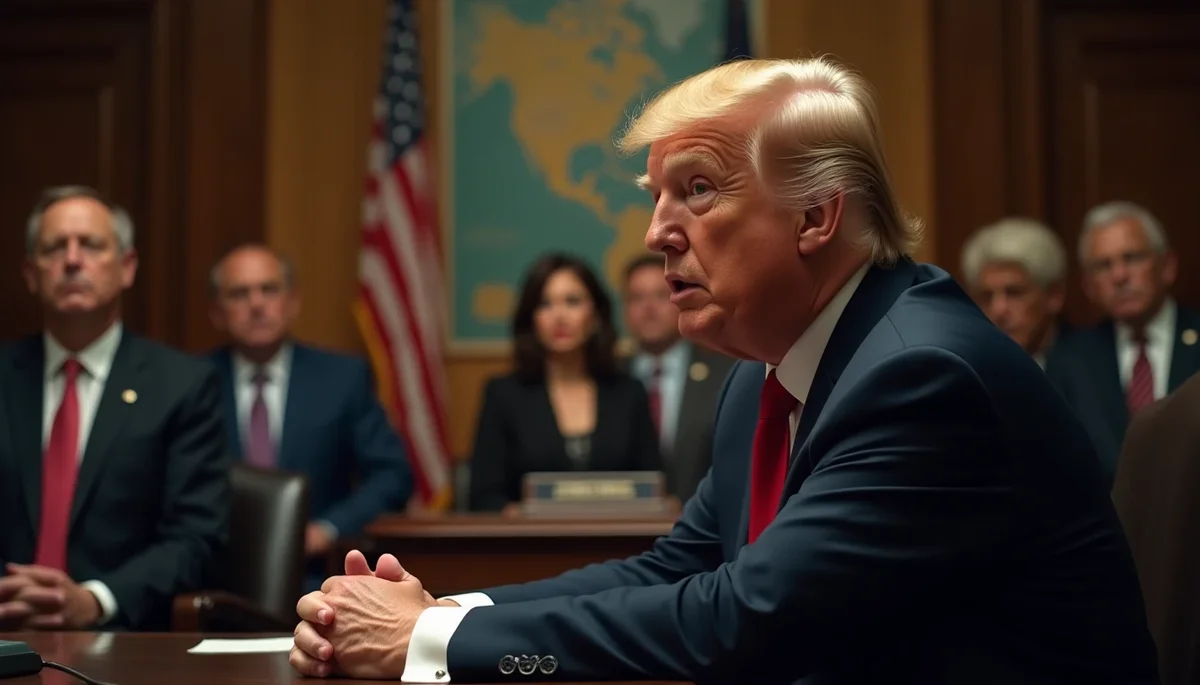
President Donald Trump issued his most direct threat against Iran to date during Monday's Mar-a-Lago summit with Israeli Prime Minister Benjamin Netanyahu, declaring the United States would 'knock the hell' out of Tehran if it attempts to rebuild its nuclear capabilities. The warning came as the two leaders addressed a constellation of Middle Eastern challenges—from Gaza ceasefire negotiations to Syria's uncertain future—while intelligence sources indicate growing Israeli concern that Iran may be pursuing chemical and biological weapons programs alongside its nuclear ambitions.
The meeting, Trump's second with Netanyahu since returning to office, produced several notable developments. On Gaza, Trump expressed hope for moving 'quickly' to the second phase of the ceasefire, while issuing a stark ultimatum to Hamas: disarm within a 'short time' or face consequences. 'There will be hell to pay,' Trump warned, though he acknowledged that he and Netanyahu 'don't agree 100 percent' on West Bank policies—a rare public admission of daylight between the close allies. Netanyahu, for his part, announced Israel would award its prestigious Israel Prize to Trump, the first time a non-Israeli has received the honor, and invited the president to visit for Independence Day celebrations.
The summit unfolded against a backdrop of intensifying regional realignments. Turkey is hosting Somali President Hassan Sheikh Mohamud this week as tensions escalate over Israel's recognition of Somaliland—a move that prompted protests in the breakaway region and drew threats from Houthi leadership that any Israeli presence there would become 'a military target.' Meanwhile, Israel continues strengthening its eastern Mediterranean posture, with Greece and Cyprus agreeing to expand joint air and naval exercises in 2026. The Iron Beam laser defense system and new SIGMA artillery cannon have officially entered Israeli service, marking a technological leap in the nation's defensive capabilities.
Yet as these geopolitical chess pieces move across the board, a quieter crisis demands attention. Writing in Harbingers Daily, theologian Jonathan Brentner poses a piercing question that should trouble every pastor and congregant: Does the silence in most churches regarding biblical prophecy grieve the Savior? Brentner recalls how Jesus wept over Jerusalem in Luke 19, lamenting that the city did not recognize 'the time of your visitation.' The parallel to our present moment is striking. As developments unfold that seem ripped from the pages of Zechariah and Matthew 24—the regathering of nations around Israel, the technological marvels of laser defense systems, the rumbling of great power competition—many pulpits remain silent on what Scripture says about the days ahead.
This pastoral abdication carries consequences beyond mere theological neglect. When churches fail to provide biblical frameworks for understanding current events, congregations are left to interpret world-shaking developments through secular lenses alone. The Abraham Accords, which Trump suggested Saudi Arabia will eventually join, represent more than diplomatic achievement—they reshape the prophetic landscape of the Middle East in ways that merit careful biblical reflection. Russia's pivot toward cryptocurrency regulation, China's Supreme People's Court calling for comprehensive digital currency laws, and the surge of tokenized assets to $17 billion all point toward the kind of global financial restructuring that Scripture suggests will characterize the end of the age.
The convergence we witness today—technological, geopolitical, and spiritual—calls for shepherds who will help their flocks understand the times. As Trump and Netanyahu negotiate the future of Gaza and contemplate strikes on Iran, as new defense systems come online and digital currencies reshape global finance, the church cannot afford to remain mute. The prophet Amos declared that the Lord does nothing without revealing His counsel to His servants the prophets. The question for our generation is whether those called to proclaim that counsel will find the courage to speak.