
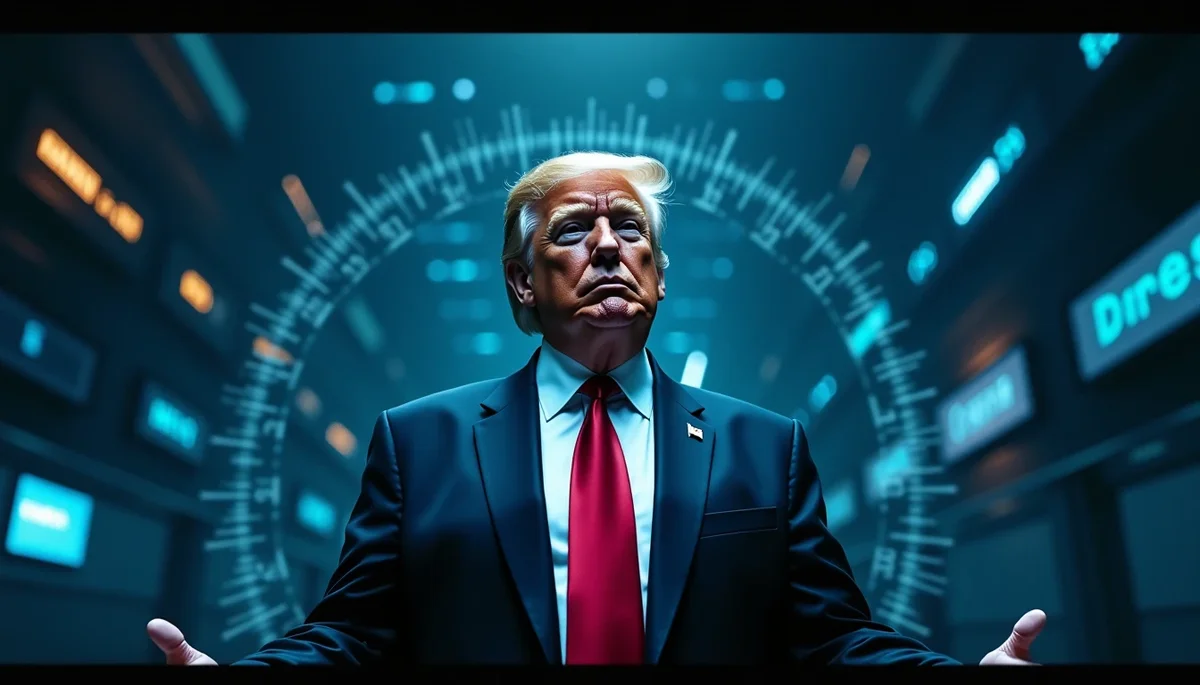
In a move that speaks volumes about the spirit of our age, President Donald Trump has added his name to the United States Institute of Peace headquarters in downtown Washington, D.C. After initially attempting to dismantle the congressionally-chartered institution through the Department of Government Efficiency, the administration has instead claimed the taxpayer-funded building as a personal monument. The sign now reads with the president's name prominently displayed above the existing building designation—a development that should give pause to anyone familiar with the biblical warnings about leaders who exalt themselves.
The prophet Daniel wrote of a king who would 'exalt himself and magnify himself above every god' (Daniel 11:36), and while we must be careful not to assign prophetic fulfillment prematurely, the pattern of self-aggrandizement using public institutions deserves sober attention. When peace itself becomes branded property, we witness something more than political theater—we observe the erosion of the very concept of servant leadership that Scripture commends.
Meanwhile, the technological infrastructure for unprecedented global control continues its rapid expansion. Chinese AI companies, emboldened by DeepSeek's disruption of Western dominance, are advancing autonomous agents capable of independent planning and action across digital environments. Major firms including Alibaba, Tencent, and ByteDance are joined by a new generation of startups in what analysts call the 'Chinese AI Tigers.' These systems no longer merely respond to queries—they reason, strategize, and execute tasks with minimal human oversight, raising profound questions about accountability and control.
The financial architecture supporting this digital transformation took another significant step forward as Hua Xia Bank, a state-linked Chinese institution, issued 4.5 billion yuan ($600 million) in tokenized bonds. These onchain government bonds were auctioned exclusively to holders of the digital yuan, China's central bank digital currency. The transaction removes intermediaries from the clearing process, demonstrating how CBDCs can fundamentally restructure financial systems. For those watching prophetic developments, the convergence of state-controlled digital currency with tokenized assets represents a significant milestone toward the kind of comprehensive economic surveillance described in Revelation 13.
Simultaneously, biometric payment systems are advancing rapidly across Asia and North America. NEC has taken a stake in PopID, while Tencent and Wink are integrating facial and palm recognition directly into point-of-sale terminals. In India, SecuGen's fingerprint scanners are advancing toward Aadhaar L1 certification, the security standard for the nation's massive digital identity system serving over a billion people. The infrastructure for 'no one could buy or sell unless he had the mark' grows more sophisticated by the day.
In the Middle East, Israel sent a delegation to Cairo seeking the immediate return of hostage Ran Gvili, with officials stating they will not advance to Phase II of the U.S. peace plan without his release. The Israeli military conducted fresh airstrikes in southern Lebanon—targeting the towns of al-Majadel, Braashit, Jbaa, and Mahrouna—less than 24 hours after historic direct talks between the two nations. Iran reportedly made secret demands regarding Israeli agriculture as leverage in hostage negotiations, while Israel faces its worst prison overcrowding crisis in history, with cells so crowded that basic daily functions are compromised.
The death of Yasser Abu Shabab, the Israel-backed militia leader in Gaza, underscores the impossibility of externally imposing leadership on the Palestinian enclave. Abu Shabab, who led the Popular Forces group in Israeli-controlled areas, was widely rejected by Palestinians despite Israeli support. His killing reveals the enormous gap between strategic aspirations and ground realities.
As we survey these developments—the elevation of personal brands over public institutions, the race toward autonomous AI and biometric control, the grinding conflicts in the Holy Land—we are reminded that Scripture speaks of a time when the love of many will grow cold and when deception will intensify. The faithful are called not to fear but to watch with discernment, understanding that these patterns, while troubling, unfold under sovereign providence. What demands our attention now is how quickly disparate technological and political threads are weaving together into something that previous generations could only imagine.