
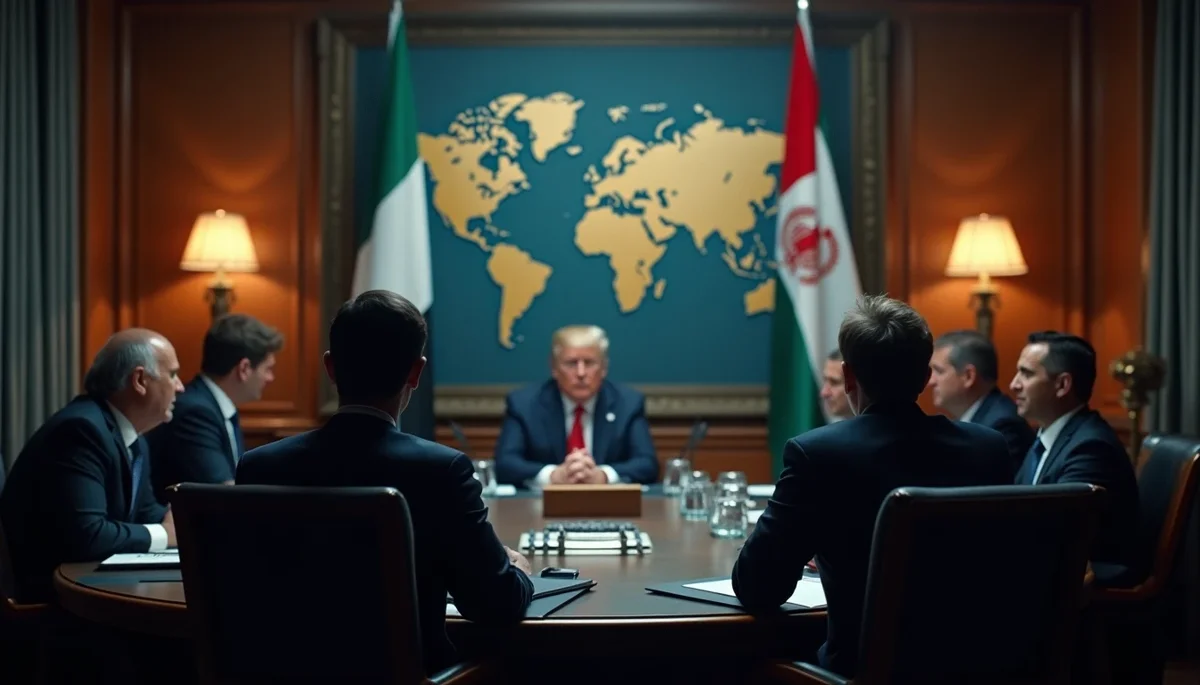
President Donald Trump is preparing to unveil Gaza's long-awaited 'Board of Peace' within weeks, signaling a formal advance to Phase Two of his postwar plan for the embattled territory. The announcement, expected imminently according to sources in Washington and Jerusalem, would establish an international governing framework for post-conflict Gaza—a development that has captured the attention of regional powers including Turkey and Egypt.
The diplomatic push comes as tensions remain acute on the ground. Israeli Defense Forces confirmed Friday that troops shot and killed a Palestinian who crossed Gaza's designated Yellow Line, underscoring the fragile security situation that any peace architecture must address. Meanwhile, newly released Hamas Interior Ministry documents—seized by the IDF and analyzed by NGO Monitor—reveal the extent to which the terror organization infiltrated and controlled foreign aid organizations operating in the territory. The exposure of Hamas's systematic takeover of humanitarian groups adds urgency to establishing legitimate governance structures.
In Jerusalem, Prime Minister Benjamin Netanyahu finds himself navigating both the peace process and personal legal peril. Reports from The Cradle indicate Netanyahu has asked President Trump for additional support in securing a pardon from Israel's president in his ongoing corruption case. The request highlights the complex web of political relationships shaping Middle East diplomacy, with Netanyahu's domestic vulnerabilities potentially influencing Israel's negotiating posture. Israel's Defense Ministry announced Friday a 2026 defense budget of 112 billion shekels, signaling the nation's continued security-first posture even as peace talks advance.
Beyond the Middle East, a parallel competition is reshaping global power dynamics. Palantir Technologies unveiled 'Chain Reaction' Thursday, billing it as the operating system for American AI infrastructure. The initiative, launched with founding partners CenterPoint Energy and NVIDIA, addresses what Palantir identifies as the critical bottleneck to AI innovation: not algorithms, but power and compute capacity. The announcement positions the U.S. in direct competition with China's rapidly advancing AI sector.
That competition took on new dimensions this week as analysis of Chinese AI companies reveals capabilities that may have been systematically underestimated. DeepSeek's R1 model recently sent shockwaves through the AI community, matching advanced offerings from OpenAI and Anthropic at a fraction of the cost. But DeepSeek represents just one player among China's 'AI Tigers'—a constellation of startups and tech giants including Alibaba, Tencent, Baidu, and ByteDance pushing the boundaries of artificial general intelligence, multimodal AI, and large language models.
The race extends beyond software. China has triggered what analysts are calling a 'DeepSeek moment' in hypersonic weapons, unveiling cement-coated Mach-7 missiles that can reportedly be mass-produced for roughly $100,000 per unit. The development has set off alarm bells within the U.S. military, which has yet to field a hypersonic weapon and cannot match the production economics.
Students of biblical prophecy will note the convergence of developments centered on Israel and technological systems that enable unprecedented surveillance and control. The establishment of international governance over Gaza, the advancement of AI systems capable of autonomous action, and the intensifying great-power competition echo themes found throughout prophetic literature—particularly the alignment of nations around Israel and the rise of systems that could facilitate the kind of global coordination described in Revelation.
What to watch: The composition of Trump's Gaza Board of Peace will reveal which nations gain influence over the territory's future. Simultaneously, the AI infrastructure race between the U.S. and China is accelerating toward capabilities that will reshape both economic and military power for decades. The intersection of Middle East diplomacy and technological supremacy may prove the defining storyline of 2025.