
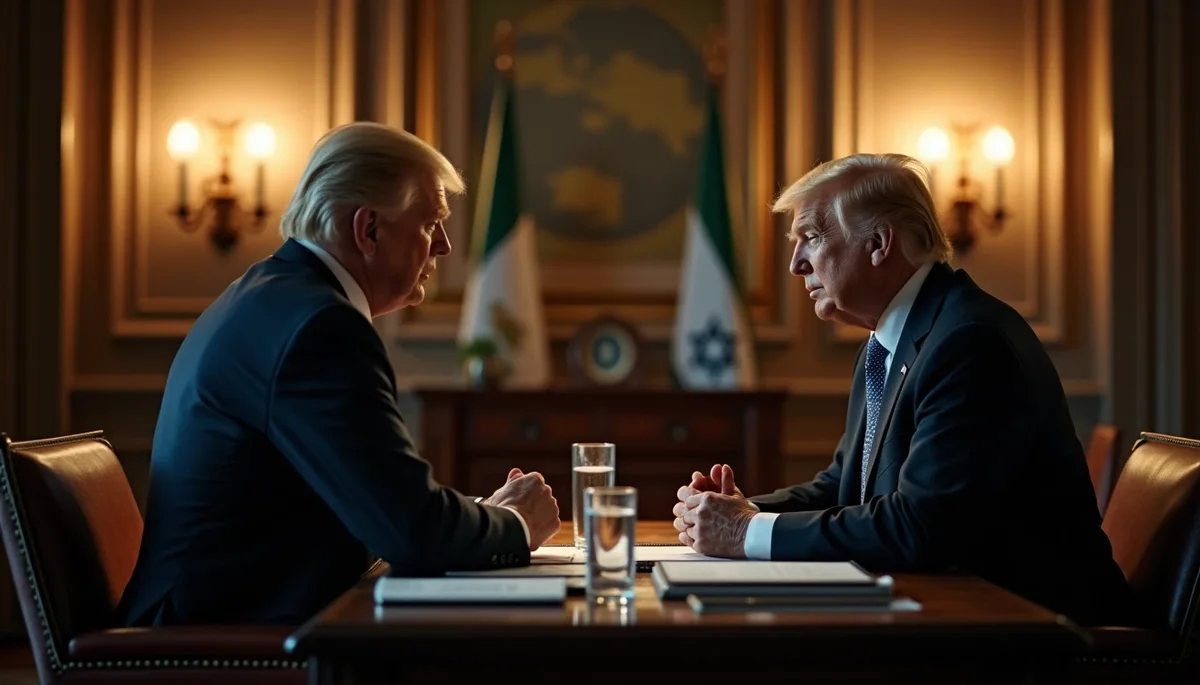
President Donald Trump ordered a wave of airstrikes against Islamic State militants in northwest Nigeria on Christmas Day, marking the first major military action of his new term. The strikes targeted ISIS fighters whom Trump accused of 'viciously killing, primarily, innocent Christians, at levels not seen for many years.' The operation signals an aggressive posture toward jihadist networks threatening religious minorities in Africa's most populous nation.
The Nigeria strikes came as Israeli security forces announced the elimination of a senior Iranian Quds Force operative in northeastern Lebanon. The IDF and Shin Bet confirmed the targeted killing, which underscores the ongoing shadow war between Israel and Iran's proxy networks despite the ceasefire framework in Lebanon. Lebanese President Joseph Aoun acknowledged that diplomatic efforts have reduced the immediate risk of renewed full-scale war with Israel, though Israeli strikes continue within Lebanese territory under existing de-escalation mechanisms.
Perhaps the most consequential development emerging from the region involves quiet but significant progress in Israel-Syria security negotiations. According to Syrian sources speaking to i24 News, talks between Jerusalem and Damascus have advanced substantially in recent weeks, with a formal security agreement now within reach. Such an accord would represent a seismic shift in regional dynamics, potentially normalizing relations between longtime adversaries and further isolating Iran's remaining influence in the Levant.
Back in Israel, Prime Minister Benjamin Netanyahu faces mounting domestic pressure over the 'Qatargate' scandal, with Finance Minister Bezalel Smotrich demanding that PMO workers involved 'must sit behind bars.' Political analysts note that Netanyahu has fanned fears of military escalation on multiple fronts—from Iran to Gaza—as a deflection strategy. The IDF, meanwhile, has formally adopted 'War of Revival' as the official designation for the ongoing conflict with Hamas, a linguistic choice carrying unmistakable biblical resonance. Chief of Staff Eyal Zamir ordered the terminology applied to all military documents, ceremonies, and statements.
The prophetic undertones extend beyond nomenclature. Diaspora Jews are purchasing homes in Israel at accelerating rates, with Jerusalem real estate transactions increasingly viewed as statements of belonging rather than mere investments. This return-to-the-land phenomenon echoes ancient patterns described by the prophets, occurring precisely as regional alignments shift in Israel's favor.
Meanwhile, a post-Christmas winter storm bears down on the U.S. Northeast, with meteorologists forecasting significant snowfall across eastern Pennsylvania, New Jersey, and the New York City metro area by week's end. The storm adds to a year marked by unusual atmospheric volatility across multiple continents.
On the technology front, China's Tsinghua University continues consolidating its position as the global epicenter of artificial intelligence development. The Beijing institution now leads worldwide in AI patent filings and has produced founders of major startups including DeepSeek. Students work alongside state-backed researchers developing proprietary chips and protocols, raising questions about the West's ability to maintain technological parity in the emerging AI arms race.
As 2025 draws to a close, the convergence of military action, diplomatic realignment, and technological competition creates a landscape of profound uncertainty. The Trump administration's willingness to strike in Africa, Israel's quiet negotiations with former enemies, and China's AI ambitions all point toward a 2026 that will test existing alliances and assumptions. Observers should watch whether the Israel-Syria talks produce a formal agreement—such a development would reshape Middle Eastern security architecture in ways not seen since the Camp David Accords.