
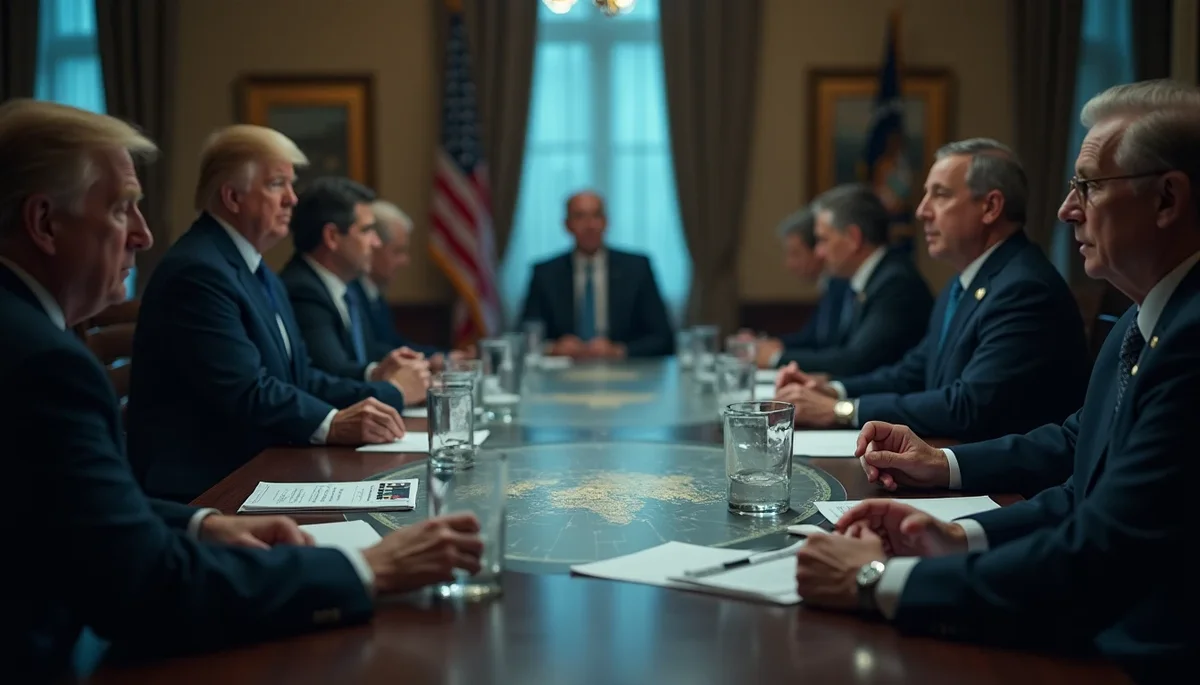
In a development that signals the acceleration of great power competition, Congress has passed and President Trump has signed the 2026 National Defense Authorization Act, marking the first time the United States military budget has officially crossed the one trillion dollar threshold. The legislation, signed late last week as Americans prepare for Christmas celebrations, represents a watershed moment in American defense spending and arrives amid mounting global instability from the Mediterranean to the Pacific.
The timing proves particularly significant as analysts observe what some are calling a deliberate restructuring of the post-World War II international order. According to geopolitical observers, the global disruptions witnessed in recent years—pandemic response, inflation, energy volatility, and regional conflicts—may represent less chaos than calculated transition. As one analysis notes, we are witnessing 'a transition from a productive capitalist model' toward something fundamentally different, what critics term a 'controlled demolition of the 20th-century social contract.' The trillion-dollar defense authorization suggests Washington is preparing for a more contested world.
Meanwhile, developments in North Africa have captured attention in diplomatic circles. Libya's Prime Minister Abdul-Hamid Dbeibah announced what he called a 'great loss' after the country's military chief was confirmed among eight people killed when a private jet crashed shortly after takeoff from Ankara, Turkey. The circumstances surrounding the crash remain under investigation, but the incident removes a key figure from Libya's already fractured political landscape. Sources familiar with Mediterranean security dynamics note that Turkey has maintained significant influence over Libya's Government of National Accord, and the loss of senior military leadership could reshape the balance of power in the oil-rich nation.
In Jerusalem, political turbulence continues as former Prime Minister Naftali Bennett has escalated attacks against Prime Minister Benjamin Netanyahu's office over what Bennett characterizes as a media influence affair allegedly connected to Qatar. Netanyahu's office has rejected the claims as fabricated, but the controversy deepens Israel's domestic political crisis even as the Gaza conflict grinds on. The United Nations aid coordination office reported Tuesday that humanitarian response in Gaza 'has not been able to keep pace with needs due to ongoing restrictions imposed by the Israeli authorities,' including limitations on materials needed to maintain sewage networks as winter storms worsen conditions across the enclave.
Against this backdrop of conflict and political maneuvering, voices within the faith community are calling for spiritual reflection. Franklin Graham, writing ahead of Christmas, urged believers to 'bow your heart and knee before the King of Kings,' noting his recent return from Buenos Aires where he reports nearly 7,000 people responded to his message. In Nigeria, a more tangible Christmas gift arrived as the remaining 130 schoolchildren and staff abducted by gunmen from a Catholic school last month were freed, ending an ordeal that had gripped the nation. The release, coming just days before Christmas, offers a rare moment of hope amid the persecution that Christian communities continue to face across parts of Africa and Asia—including reports of mass arrests of Christians in China's Zhejiang province.
The financial architecture underpinning global commerce is also undergoing rapid transformation. Payment companies raised a record $6.2 billion in 2025, representing more than a 1,000% increase from the previous year's $540 million, as investors position themselves for what many see as blockchain-based infrastructure replacing traditional settlement systems. Circle's $1.05 billion initial public offering led the surge, signaling institutional confidence in digital payment rails.
For those watching prophetic developments, the convergence of unprecedented military spending, regional power vacuums, humanitarian crises in the Holy Land, and the restructuring of global financial systems presents a sobering picture as 2025 draws to a close. The ancient prophet Daniel spoke of a time when 'many shall run to and fro, and knowledge shall increase'—a description that resonates as trillion-dollar budgets, digital currencies, and geopolitical realignments reshape the world order. What emerges from this transition remains to be seen, but the velocity of change demands vigilant attention.