
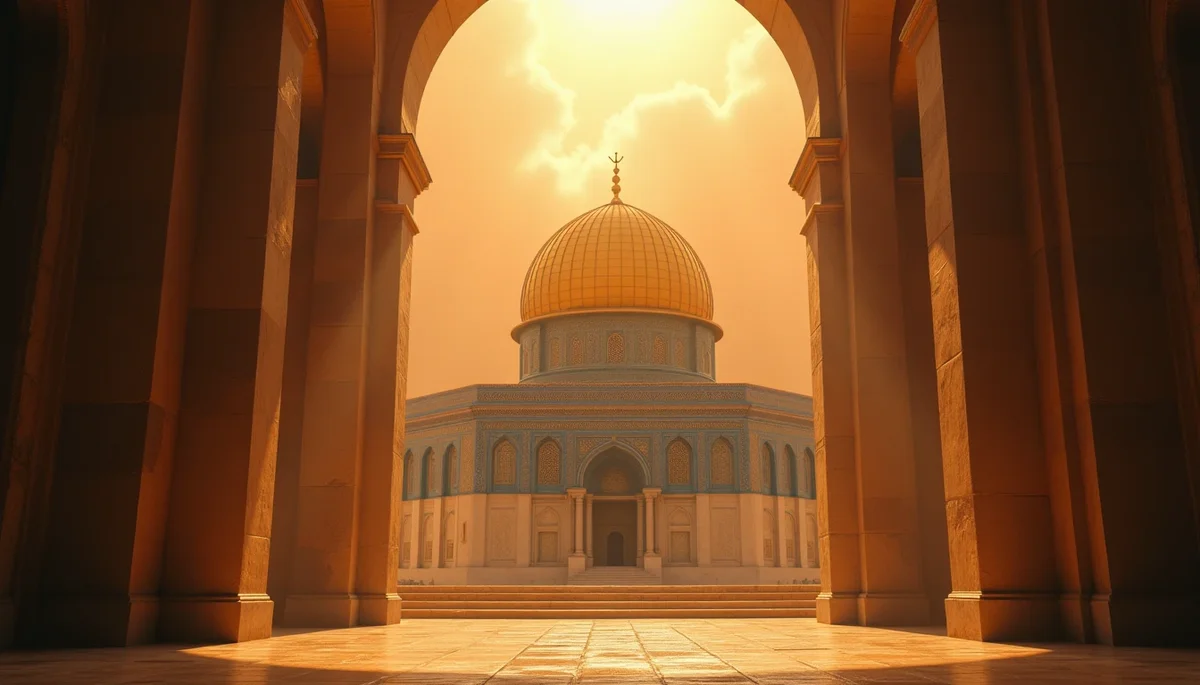
The numbers tell a story that echoes through millennia of prophetic literature. In 2025, exactly 76,448 Jews ascended to the Temple Mount—Judaism's holiest site—shattering all previous records with a 31% increase over the prior year. This sevenfold surge since 2015, when only 10,700 made the pilgrimage, represents more than statistical growth. It signals a fundamental shift in Jewish religious consciousness regarding the sacred platform where Solomon's Temple once stood and where, according to biblical prophecy, a Third Temple will one day rise.
The acceleration of Temple Mount visits occurs against a backdrop of regional upheaval that would have seemed unimaginable even months ago. As the new year dawns, Iran's streets burn with the flames of popular uprising. Protests that began over the collapsing rial have now spread to at least 17 of the country's 31 provinces, with security forces killing at least five demonstrators as of Thursday. The Critical Threats Project documented 31 separate demonstrations on December 31 alone, with crowds openly calling for regime change. The Islamic Republic—long Israel's most formidable regional adversary—faces its most serious internal challenge since the 2022 protests, this time driven by economic desperation as food inflation crushes ordinary Iranians.
Meanwhile, Israel has made a bold geopolitical move that caught many observers off guard. Last weekend, Jerusalem extended formal recognition to Somaliland, the breakaway republic on the Horn of Africa, becoming the first UN member state alongside Taiwan to do so. The strategic calculus is clear: Somaliland's position jutting into the Gulf of Aden offers a potential counterweight to Houthi disruption of Red Sea shipping lanes. Somalia's president immediately accused Israel of plotting to resettle Gazans there or establish a military base—claims Somaliland's government dismissed as 'baseless allegations.' Yet the recognition represents a significant expansion of Israel's diplomatic footprint in a region where Ethiopia, another Abraham Accords prospect, shares Somaliland's western border.
The prophetic student will note how these developments align with ancient patterns. Ezekiel 38 speaks of a coalition including Persia—modern Iran—moving against Israel in the latter days, yet that same nation now convulses with internal strife that threatens the regime's very survival. The prophet Isaiah declared that the Lord would 'set up a banner for the nations, and will assemble the outcasts of Israel, and gather together the dispersed of Judah from the four corners of the earth.' The record Temple Mount numbers suggest a spiritual awakening among Jews worldwide regarding their connection to this contested thirty-five acres in Jerusalem.
In Gaza, the humanitarian situation remains dire as Israel's ban on certain aid organizations took effect with the new year. UN agencies warn that restrictions on 37 aid groups will undermine crucial relief work in the war-battered Strip. Yet diplomatic pressure intensifies: Israeli media reports that Jerusalem and Washington have reached an understanding giving Hamas a two-month ultimatum to fully disarm—a deadline that, if enforced, could reshape the conflict's trajectory. Meanwhile, IDF forces uncovered a massive Hamas tunnel near the Gaza border after heavy storms caused ground collapse, the reinforced passage apparently designed to move fighters or hostages toward nearby refugee camps.
Prime Minister Netanyahu's presence at Mar-a-Lago for Trump's New Year's Eve celebration, following meetings with prominent Christian Zionist leaders, underscores the theological dimension of these geopolitical alignments. The convergence of evangelical support for Israel with Jewish religious revival at the Temple Mount creates a unique moment in the long history of Jerusalem.
What observers should watch in the coming weeks: whether Iran's protests reach critical mass that threatens regime stability, how the Hamas disarmament deadline unfolds, and whether Somaliland recognition signals broader Israeli diplomatic expansion along the Red Sea corridor. The ancient prophets spoke of a time when all nations would be gathered concerning Jerusalem. That gathering—whether in support or opposition—accelerates daily.