
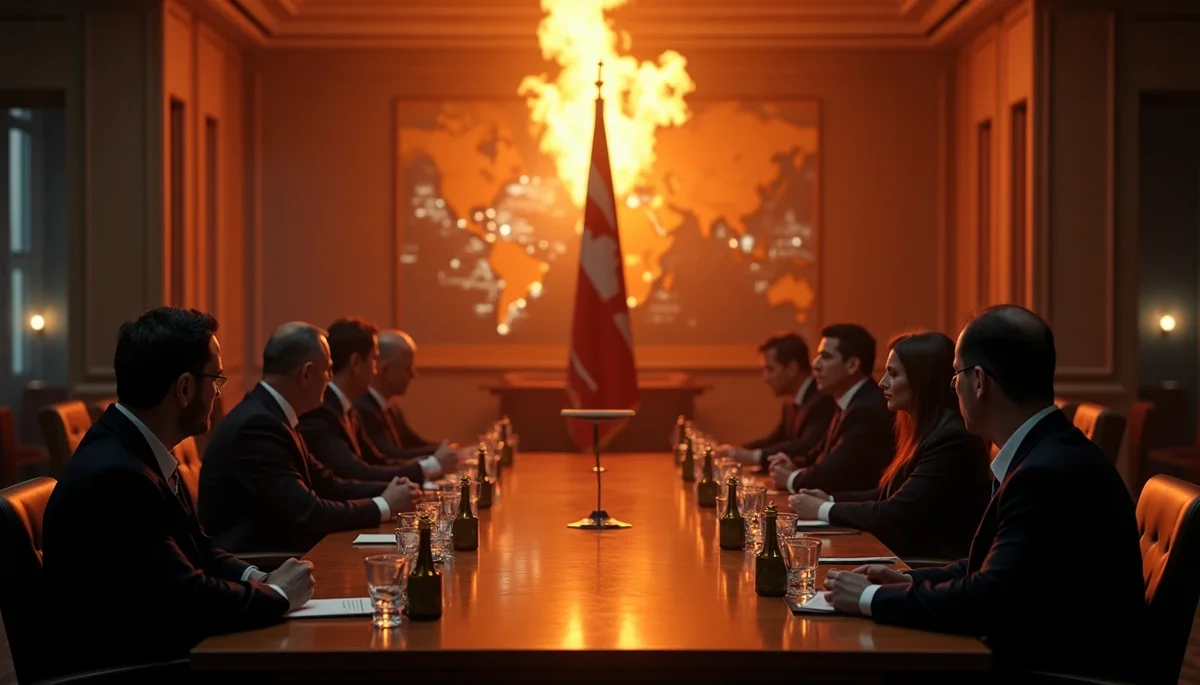
As 2025 draws to a close, the streets of Tehran tell a story that transcends currency charts and protest slogans. For the fourth consecutive night, Iranian demonstrators have attempted to breach government buildings, their anger fueled by a currency collapse that has pushed the rial to historic lows. The unrest, spreading across multiple cities, represents more than economic frustration—it signals the potential unraveling of a regime that has long positioned itself as a pillar of regional resistance.
The timing proves significant. As Iran's domestic stability crumbles, the broader Middle East enters 2026 with unresolved tensions that biblical scholars have long identified as prophetically significant. The ancient land of Persia, central to eschatological frameworks from Daniel's visions to modern interpretive traditions, now faces internal pressures that could reshape regional alignments. Israeli Defense Minister Israel Katz, visiting West Bank military installations Wednesday, instructed commanders to prepare for potential October 7-style attacks—a stark reminder that the region's security architecture remains fragile despite territorial gains against Hezbollah in Lebanon.
The Lebanese situation itself reaches a critical juncture as the government's deadline for Hezbollah disarmament expires with the calendar year. The Iranian-backed group has flatly rejected the U.S.-brokered plan, calling it a 'grave sin' and promising to treat the decree 'as if it does not exist.' This defiance, occurring as Tehran struggles to maintain domestic order, illustrates the complex web of proxy relationships that could either strengthen or fracture under pressure.
Meanwhile, the architecture of global finance continues its quiet transformation. India's Reserve Bank issued a pointed warning this week that stablecoins pose unacceptable risks to financial stability, explicitly advocating for central bank digital currencies over privately issued alternatives. The statement carries weight beyond regulatory preference—it represents a sovereign pushback against the decentralized financial infrastructure that has gained momentum throughout 2025.
The digital currency battlefield extends to Pakistan, where former Binance CEO Changpeng Zhao declared the nation could become a global crypto hub within five years if current regulatory momentum continues. The contrast is striking: India, the world's most populous nation, moves toward state-controlled digital money while its neighbor embraces decentralized alternatives. This divergence mirrors broader global tensions between centralized control and distributed systems—a technological manifestation of ancient struggles over power and autonomy.
Ethereum's record-breaking 2.2 million transactions on December 30 demonstrates that despite regulatory headwinds, decentralized infrastructure continues scaling. Yet the network's operators lost over $100 million in fee revenue this year, raising questions about the sustainability of blockchain economics even as adoption accelerates.
The natural world offers its own reminders of instability. Volcanic activity intensified across multiple continents this week, with Etna's summit craters showing significant escalation since Christmas Eve. Russia's Kamchatka Peninsula hosts ongoing eruptions at both Sheveluch and Krasheninnikov volcanoes, while Guatemala's Santiaguito continues its persistent activity. A magnitude 4.9 earthquake struck northern California near Susanville, generating over 1,300 felt reports—a reminder that seismic forces respect no calendar.
In Texas, a proposed 400-acre Muslim development near the town of Josephine has sparked controversy that touches on religious freedom, community planning, and the broader tensions surrounding faith-based enclaves in American society. The situation echoes historical patterns of religious communities seeking separation while raising contemporary questions about integration and coexistence.
As observers of prophetic patterns, the convergence demands attention: Persia in turmoil, digital systems competing for monetary supremacy, the earth itself restless beneath our feet. The Hostages and Missing Families Forum in Israel announced its closure after 817 days of operation, a somber milestone marking the transition from crisis response to prolonged uncertainty. Palestinian Authority Chairman Mahmoud Abbas marked Fatah's 61st anniversary by declaring that no force will prevent Palestinian statehood—rhetoric that gains new weight as regional powers recalibrate their positions.
What emerges from this final day of 2025 is not a single headline but a pattern: systems under stress, alignments shifting, and the persistent question of whether human institutions can manage the forces they have unleashed. For those watching through a prophetic lens, the answer has always been written. The question is whether we recognize the chapter we are reading.