
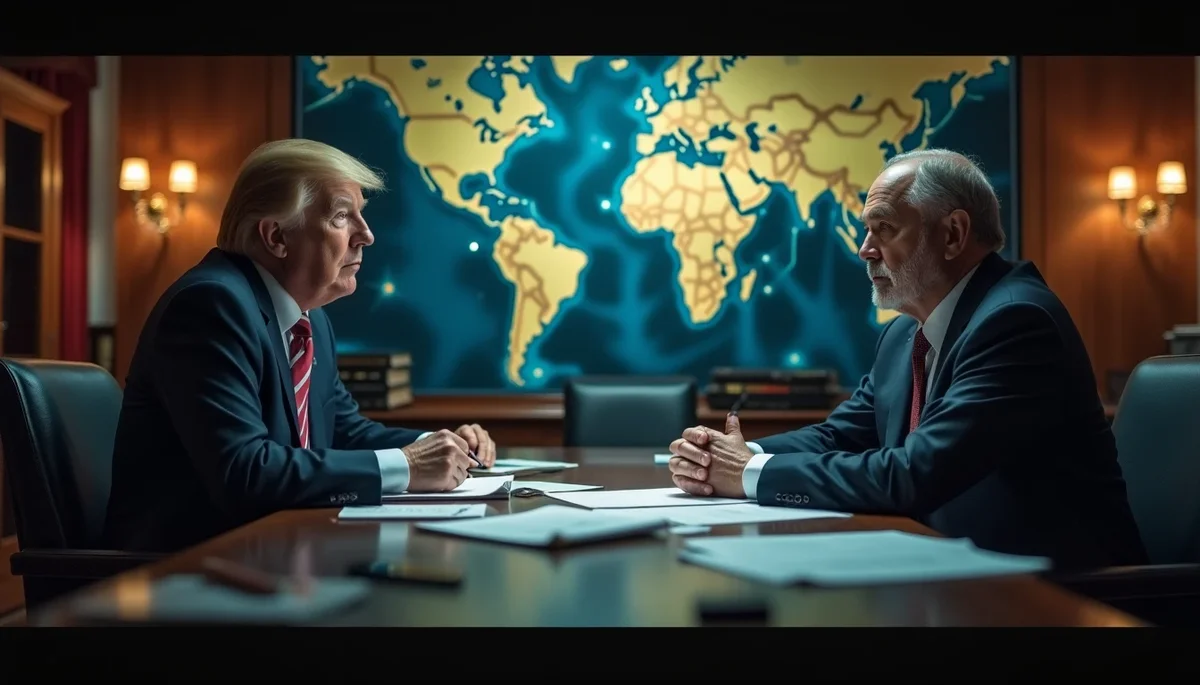
The United States has dramatically escalated its enforcement of international sanctions by seizing a large crude tanker transporting oil from both Venezuela and Iran, a move that signals Washington's willingness to physically interdict the shadow fleet sustaining sanctioned regimes. The seizure, announced Wednesday, marks one of the most aggressive enforcement actions in recent memory and immediately triggered sharp diplomatic protests from both Caracas and Tehran, raising tensions across multiple strategic theaters simultaneously.
This maritime confrontation unfolds against the backdrop of the House of Representatives passing a massive $901 billion National Defense Authorization Act in a 312-112 vote Wednesday evening. The bipartisan support—rare in this fractious Congress—reflects a growing consensus that American military power must be positioned for an era of intensifying great power competition. The legislation now heads to the Senate, where passage appears likely. Speaker Mike Johnson shepherded the compromise through after a drama-filled day of vote-trading on the House floor, underscoring both the bill's importance and the political complexity of modern defense spending.
The convergence of aggressive sanctions enforcement and unprecedented defense appropriations carries echoes of previous moments when empires consolidated their economic and military instruments before periods of significant conflict. The prophet Ezekiel spoke of a time when nations would be 'hooks in the jaws' of others, drawing them inexorably toward confrontation. Iran's deepening reliance on shadow shipping networks—now directly challenged by American seizures—represents precisely this kind of entanglement, where economic desperation drives increasingly risky behavior.
Meanwhile, in a significant development for human rights accountability, Amnesty International released a 173-page report accusing Hamas and other Palestinian armed groups of crimes against humanity during and after the October 7, 2023 attack. This marks the first time the organization has leveled such charges against Hamas, having previously focused criticism primarily on Israel's military response. The report documents violations of international humanitarian law and war crimes, providing what scholars may view as crucial documentation for future tribunals.
Secretary of State Marco Rubio met with Israeli Foreign Minister Gideon Sa'ar in Washington to discuss Gaza's future, Syria, and Lebanon, while President Trump announced that membership for his proposed Gaza 'Board of Peace' would be revealed in early 2026. Global leaders are reportedly seeking seats on this governing body, though its precise structure and authority remain undefined. In a parallel development revealing the complex web of religious and political interests in the region, over 1,000 American Christian Zionist pastors completed a week-long visit to Israel funded by the Israeli Foreign Ministry and overseen by Ambassador Mike Huckabee.
On the technological frontier, Google's DeepMind announced it will open its first automated research laboratory in the United Kingdom next year, part of a broader agreement with the British government to accelerate AI-driven scientific discovery. The facility will focus on developing new materials for batteries and semiconductors, with AI models like Gemini supporting the research. Parent company Alphabet expects capital expenditures to exceed $93 billion by year's end, with even larger investments planned for 2026. The race to achieve transformative AI capabilities increasingly resembles an arms race, with infrastructure investments serving as the ammunition.
Financial markets reveal their own anxieties. According to XWIN Research Japan, crypto hedge funds and institutional players are shifting into 'risk-off mode,' moving substantial holdings into stablecoins ahead of the December Federal Open Market Committee meeting. On-chain data shows a notable divergence in positioning, with large players hedging against volatility even as Bitcoin holds above $92,000. This defensive posture ahead of monetary policy decisions suggests sophisticated investors see turbulence on the horizon.
The threads connecting these developments—military spending, sanctions enforcement, regional realignment, AI acceleration, and financial hedging—weave a tapestry of preparation. Whether for conflict, transformation, or both, the powers of this age are positioning themselves for what comes next. Observers would do well to watch not only the headlines but the infrastructure being built beneath them.