
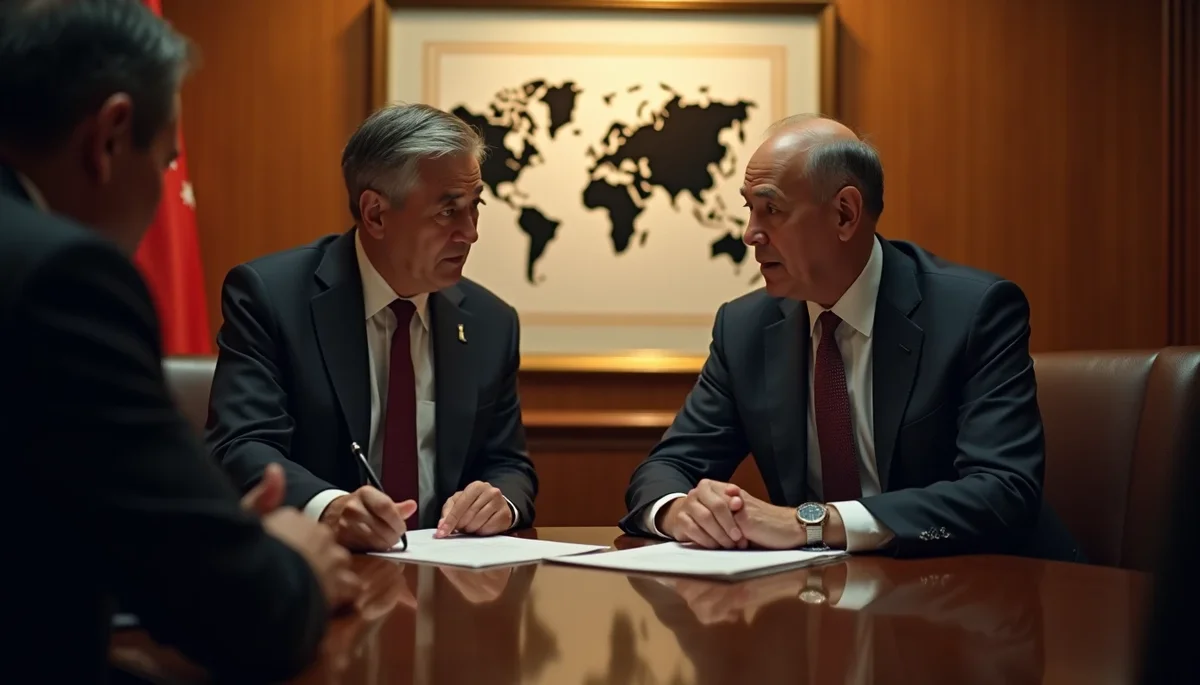
In a development that underscores the rapidly evolving geopolitical landscape, Taiwan's Deputy Foreign Minister Francois Wu conducted a previously undisclosed visit to Israel recently, according to three sources familiar with the trip who spoke to Reuters. The secret diplomatic mission comes as Taiwan actively seeks defense cooperation with Jerusalem, particularly in the wake of Israel's demonstrated military capabilities against Hezbollah and Hamas. This quiet rapprochement between two nations facing existential threats from larger neighbors represents precisely the kind of alliance-building that reshapes regional power dynamics in ways few anticipated.
The visit coincides with intensified American engagement across the Middle East. US Ambassador Tom Barrack, speaking at The Jerusalem Post conference in Washington on December 10, urged Israel to 'seize the moment' regarding Syria's new leadership. 'After October 7, Israel doesn't trust anyone,' Barrack declared. 'That's why we've offered to serve as a peacekeeping force. Verification replaces trust.' Meanwhile, President Isaac Herzog met with US UN Ambassador Mike Waltz in Jerusalem to discuss implementation of the Gaza peace framework, with President Trump announcing he will name members of his proposed Gaza Board of Peace 'early next year.'
Yet even as diplomatic channels hum with activity, the spiritual dimension of the conflict remains starkly evident. Hamas leadership continues to refuse disarmament, with analysts at Harbingers Daily characterizing the organization's ideology as fundamentally incompatible with Western diplomatic assumptions. The prophet Zechariah spoke of Jerusalem becoming 'a cup of trembling' to surrounding peoples—a description that grows more apt with each passing week as the ancient city remains the focal point of competing visions and irreconcilable claims.
On the domestic front, a fierce debate over digital identity and surveillance has erupted in Washington. Conservative Republicans expressed frustration after the House passed the National Defense Authorization Act without the promised ban on central bank digital currencies. The omission has intensified concerns about governmental overreach, particularly as new proposals for mandatory age verification across the internet gain momentum globally. Critics warn these measures could serve as a Trojan horse for comprehensive digital identification systems. The U.S. Customs and Border Protection has simultaneously proposed sweeping new entry screening protocols that would extend surveillance into the digital lives of foreign nationals—a development that positions America among the most demanding Western democracies for entry requirements.
Interestingly, Norway's central bank announced this week that a CBDC is 'not warranted at this time,' citing the country's robust existing payment infrastructure. This decision stands in contrast to the accelerating digital currency initiatives elsewhere and may signal growing skepticism about the necessity of central bank digital currencies among some Western nations. The tension between technological capability and appropriate restraint echoes ancient wisdom about the proper limits of human systems and authority.
A new report has also drawn attention to cultural battlegrounds, documenting what researchers describe as an aggressive LGBT agenda in children's programming on major streaming platforms. The findings have reignited debates about parental rights and the ideological formation of young minds—concerns that resonate with biblical warnings about those who would lead children astray.
As these threads converge—secret diplomatic missions, digital surveillance debates, cultural conflicts, and the ever-present tensions surrounding Israel—observers would do well to note how quickly the architecture of global order is being reconstructed. The prophet Daniel spoke of a time when 'knowledge shall increase' and 'many shall run to and fro.' We are witnessing not merely isolated developments but the emergence of new patterns of alliance, control, and conflict that merit careful attention in the days ahead.