
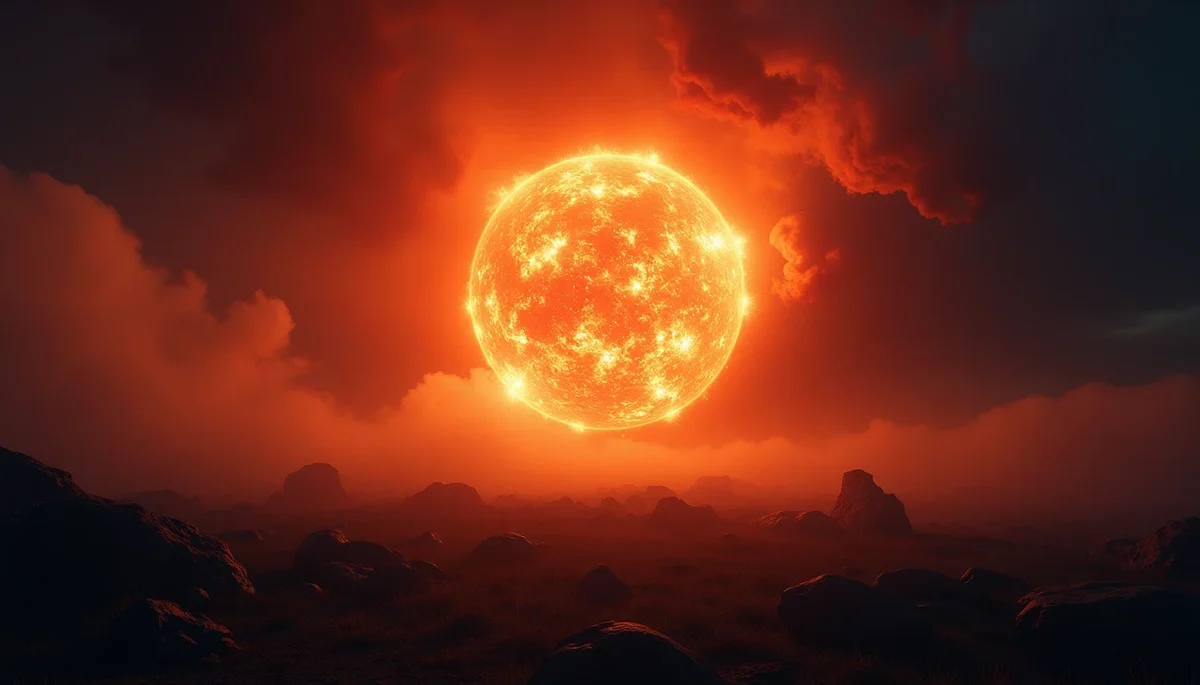
A coronal mass ejection hurtles toward Earth today as our planet's crust shudders across multiple continents, creating a convergence of celestial and terrestrial disturbances that demands attention from observers of natural phenomena.
The National Oceanic and Atmospheric Administration's Space Weather Prediction Center confirms that fast solar wind continues streaming toward Earth, with an incoming solar blob—a coronal mass ejection—expected to disturb our planet's space environment within the next 24 to 48 hours. This visualization of high-speed solar wind working in tandem with the approaching CME suggests potential geomagnetic storm conditions that could affect satellite communications, GPS accuracy, and power grid stability. The sun's current activity level, while not reaching X-class flare intensity, represents a sustained period of elevated output that space weather forecasters are monitoring closely.
Meanwhile, California's Humboldt County experienced a rare meteorological event on Saturday when the National Weather Service issued a tornado warning for Shelter Cove—an unusual occurrence for this region of the Pacific Coast. A powerful atmospheric river drove high winds that toppled trees and severed power lines, leaving nearly 2,000 residents without electricity. Highway 254 closed as emergency crews worked to clear debris, while residents of this remote coastal community sheltered in place. The combination of tornado-favorable conditions within an atmospheric river system demonstrates the increasingly unpredictable nature of weather patterns along the West Coast.
The seismic picture today reveals a restless planet. A magnitude 5.7 earthquake struck the remote Prince Edward Islands region in the southern Indian Ocean at 13:07 UTC, followed by a magnitude 5.1 temblor 158 kilometers south-southeast of Vilyuchinsk on Russia's Kamchatka Peninsula. Ethiopia's Tigray region recorded a magnitude 4.5 earthquake 60 kilometers northeast of Mek'ele, with at least one felt report confirming ground motion was perceptible to residents. Closer to American shores, a magnitude 3.3 earthquake rattled areas east of Huntsville, Utah, generating 160 felt reports, while a magnitude 2.9 event near Corralitos, California prompted 478 residents to submit felt reports to the USGS.
The Kamchatka Peninsula continues its seismic restlessness with multiple events today, including a magnitude 4.5 earthquake 212 kilometers south-southeast of Vilyuchinsk and a magnitude 4.4 event 128 kilometers east of Petropavlovsk-Kamchatsky. This volcanic arc, part of the Pacific Ring of Fire, regularly produces significant seismic activity, but the clustering of events warrants continued observation.
Volcanic activity worldwide adds another dimension to today's natural phenomena report. Indonesia's Ibu volcano on Halmahera Island produced an ash plume reaching flight level 150—approximately 15,000 feet—prompting aviation advisories from the Darwin Volcanic Ash Advisory Center. Semeru volcano in East Java continues its explosive activity, while Popocatépetl in Mexico, Reventador in Ecuador, and Fuego in Guatemala maintain their persistent rumbling. The Afar region of Ethiopia, where today's earthquake occurred, sits atop one of the most geologically active zones on Earth, where tectonic plates are slowly pulling apart.
For those who study patterns in natural phenomena, today's convergence of solar, atmospheric, and seismic events across such disparate locations—from the remote southern ocean to the volcanic arcs of the Pacific Rim to the rift valleys of East Africa—presents a snapshot of our dynamic planet. The prophet Joel spoke of wonders in the heavens and signs on the earth; whether one interprets these events through a spiritual lens or purely scientific observation, the data confirms we inhabit a world in constant motion. Watch the aurora forecasts over the next two days as that solar blob arrives, and monitor the Kamchatka seismic network for any escalation in the current swarm activity.