
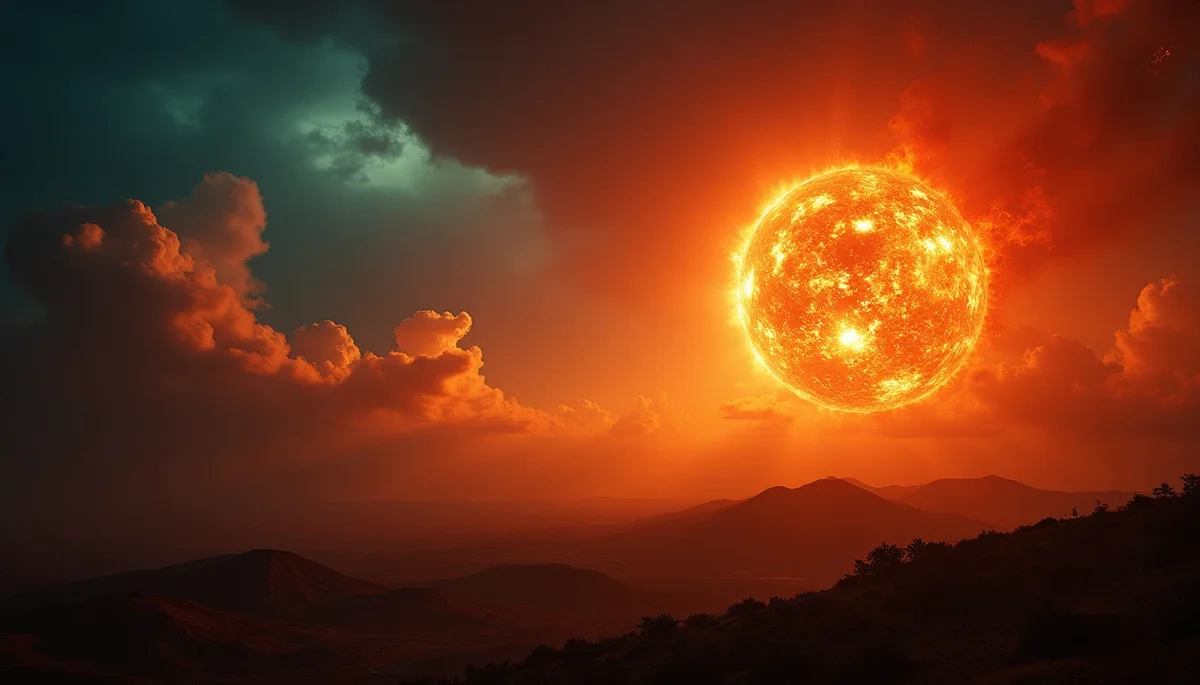
The sun is waking up with renewed fury. GOES-19 satellite instruments captured a powerful M5-class solar flare erupting from an active region near the Sun's southeast limb on December 26-27, pushing solar activity to high levels for the first time in weeks. The 131-angstrom wavelength imagery reveals extremely hot flare plasma coursing through the solar corona, a reminder that our star operates on its own schedule, indifferent to human calendars. Space weather forecasters are monitoring for potential coronal mass ejections that could trigger geomagnetic storms in the coming days—a phenomenon that disrupts communications, satellite operations, and power grids with increasing frequency as we approach solar maximum.
Meanwhile, the earth beneath our feet continues its restless shifting. The past 24 hours have registered 556 earthquakes globally, including five events exceeding magnitude 5.0. The most significant struck 37 kilometers northwest of Añatuya, Argentina, at a depth of 588 kilometers—a deep-focus event that sent seismic waves rippling across the South American plate. India's Assam region felt a magnitude 4.5 tremor near Dhekiajuli, while California's Valencia area experienced a 2.7 magnitude shake, and Louisiana recorded unusual seismic activity near Pleasant Hill. From Alaska's Gulf waters to Indonesia's Bengkulu coast, the planet's tectonic systems remain in constant motion.
These natural phenomena unfold against a backdrop of escalating geopolitical tensions centered on the Horn of Africa. Somalia is demanding Israel reverse its recognition of Somaliland, with State Minister for Foreign Affairs Ali Omar calling the move an act of 'state aggression that will never be tolerated.' The diplomatic firestorm has united unlikely allies: Qatar, Egypt, Djibouti, Turkey, and African Union ministers have all condemned Israel's recognition of the breakaway region. Hamas issued its own condemnation, accusing Somaliland of setting 'a dangerous precedent' and linking the recognition to broader Israeli objectives regarding Palestinian displacement from Gaza.
The Somaliland recognition represents a significant shift in Israel's strategic posture in the Red Sea region, potentially securing naval access and intelligence cooperation in waters increasingly contested by Houthi forces and Iranian proxies. Turkey, meanwhile, demonstrates its own strategic calculus by doubling down on Russian energy ties with a $9 billion commitment to nuclear power development—a move that underscores the fracturing of traditional alliance structures across the Middle East and beyond.
In the West Bank, security forces apprehended a gunman who opened fire near the Hashmonaim checkpoint, though no casualties were reported. The incident follows Thursday's combined terror attack in northern Israel that killed two people across three sites. These events occur as Haaretz publishes a sobering reflection on the Palestinian Nakba, arguing that the displacement that began in 1948 continues in various forms today—a perspective that gains urgency as Gaza's humanitarian crisis deepens and settler violence in the West Bank intensifies.
The convergence of celestial activity and terrestrial upheaval carries echoes of prophetic literature, where signs in the heavens and shakings of the earth precede pivotal moments in human history. The prophet Joel spoke of wonders in the heavens and on the earth before the great and terrible day of the Lord. Whether one reads these events through a prophetic lens or purely scientific observation, the pattern is undeniable: natural systems and human conflicts are intensifying simultaneously.
As 2025 draws to a close, observers should watch for continued solar activity that could peak in early 2026, along with diplomatic fallout from the Somaliland recognition that may reshape Red Sea security dynamics. The Federal Reserve's acknowledgment that pandemic-era policies widened America's wealth gap adds economic instability to an already volatile global picture. In such times, both ancient wisdom and modern science counsel the same response: vigilance, preparation, and clear-eyed assessment of the forces—natural and human—that shape our world.