
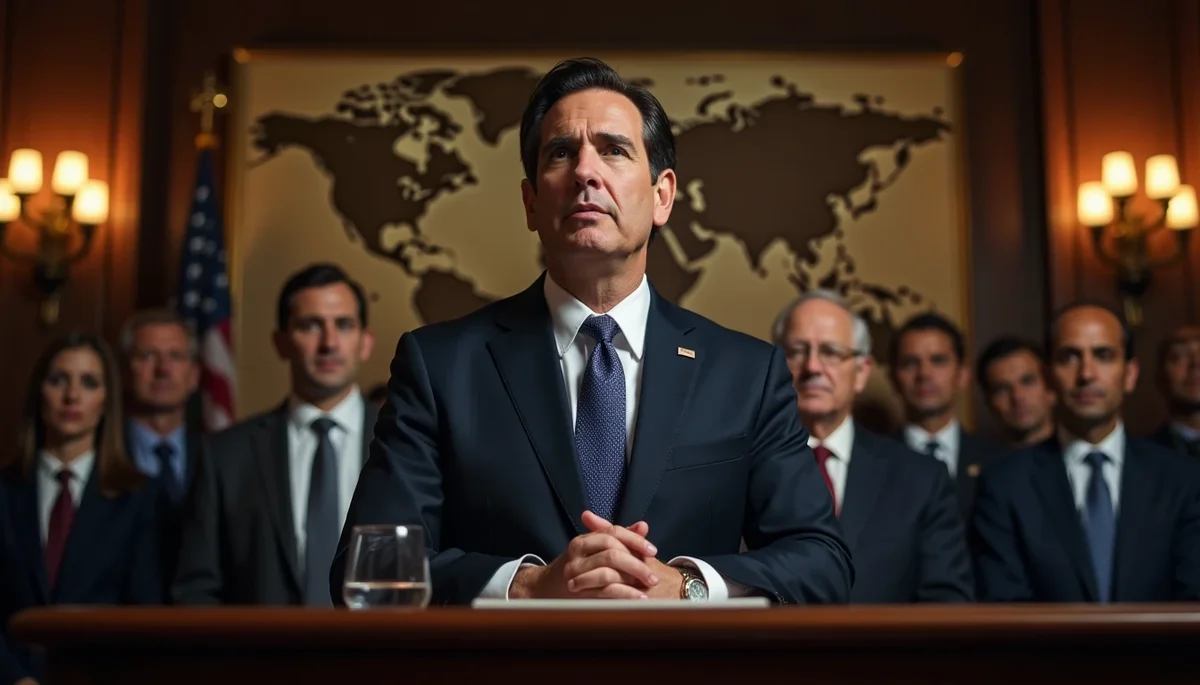
Secretary of State Marco Rubio delivered a significant policy announcement Friday, confirming that Washington will press forward with an ambitious governance framework for Gaza that includes an international oversight board, Palestinian technocrats, and the eventual deployment of foreign stabilization forces. The announcement marks a decisive American push to cement the fragile ceasefire between Israel and Hamas into something more durable—a post-conflict architecture that sources in the region describe as the most comprehensive reconstruction plan since the conflict's devastating escalation.
The proposed structure would place day-to-day administration in the hands of Palestinian technical experts while an international board provides oversight and, critically, legitimacy in the eyes of both regional powers and the broader international community. Egyptian Foreign Minister Badr Abdelatty, speaking from Ankara, emphasized that lasting peace remains 'contingent upon Israeli cooperation,' signaling Cairo's intention to remain deeply engaged in implementation. Egypt's positioning as a guarantor of any Gaza settlement reflects its enduring strategic interest in preventing instability along its northeastern border—a calculus that has driven Egyptian diplomacy since the Camp David Accords.
The diplomatic maneuvering around Gaza unfolds against a backdrop of intensifying great-power realignment. Analysts at Zero Hedge this week examined the potential for a Russian-American 'New Détente' that could fundamentally reshape global economic architecture. While such speculation remains preliminary, the mere discussion reflects a shifting landscape where traditional alliances face stress tests and new configurations seem possible. For students of biblical prophecy, the realignment of nations around the Middle East—particularly involving ancient territories like Persia, Egypt, and the land of Israel—invites careful observation. The prophet Ezekiel spoke of coalitions forming in the latter days, and while prudent analysts avoid date-setting, the current diplomatic ferment warrants attention.
Meanwhile, the earth itself offered reminders of human fragility. A swarm of earthquakes rattled San Ramon, California early Saturday morning, with magnitudes reaching 4.0 on the Richter scale. The USGS recorded over 2,100 'Did You Feel It?' reports from residents jolted awake in the predawn hours. The tremors struck along the Calaveras Fault, a known seismic hazard threading through the East Bay's suburban communities. Separately, a 2.6-magnitude quake registered near Mentone, Texas, while Ecuador experienced a more significant 5.1-magnitude event northwest of Archidona. Globally, seismologists logged 482 earthquakes in the past 24 hours, including 28 events above magnitude 4.0—a reminder that the planet's tectonic forces operate on their own timetable, indifferent to human affairs.
The convergence of seismic activity with geopolitical tremors carries symbolic weight for those attuned to prophetic literature. Christ's Olivet Discourse famously enumerated earthquakes among the signs preceding the end of the age—not as singular predictors, but as part of a pattern Jesus compared to birth pangs, increasing in frequency and intensity. Whether one interprets such passages literally or metaphorically, the juxtaposition of ground-shaking events with diplomatic upheaval in the Holy Land creates a moment that demands thoughtful engagement rather than sensationalism.
In the financial sphere, developments continue that merit monitoring. Swedish fintech giant Klarna announced a partnership with Coinbase to accept USDC stablecoin deposits from institutional investors, further blurring the lines between traditional finance and cryptocurrency infrastructure. Poland's parliament, meanwhile, pumped the brakes on crypto legislation after a controversial bill revival drew presidential opposition, pushing substantive debate into January. These incremental steps toward digital currency integration may seem distant from Middle Eastern diplomacy, but they represent threads in the same tapestry of global transformation.
As 2025 draws toward its close, the convergence of these storylines—American-led reconstruction efforts in Gaza, Egyptian diplomatic engagement, great-power realignment discussions, and seismic reminders of planetary instability—suggests a world in transition. Informed observers would do well to watch how the Gaza governance framework develops in the coming weeks, whether Cairo and Washington can maintain coordination, and how regional powers like Iran respond to diminished leverage following setbacks in Syria. The ground, both literally and figuratively, remains unsettled.