
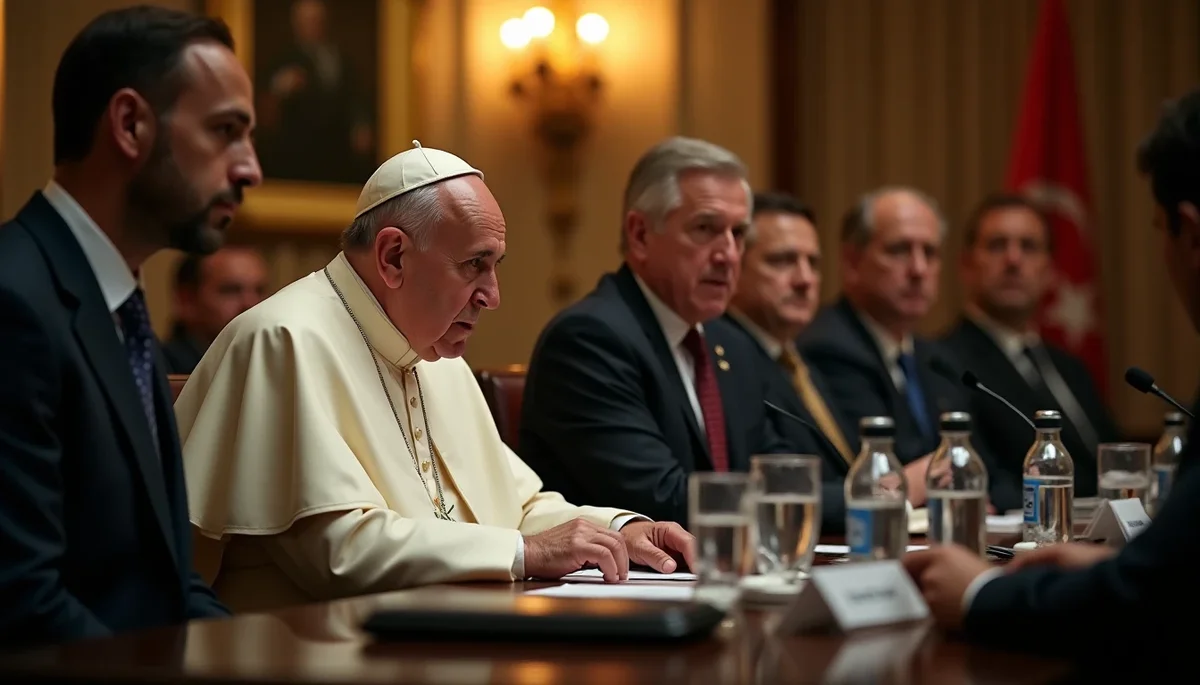
Pope Leo XIV's historic visit to Lebanon has stumbled badly, marked by what observers describe as three significant diplomatic missteps in a country still reeling from Hezbollah's grip and regional instability. The pontiff, formerly Robert Francis Prevost of Chicago, arrived in the war-torn nation just as tensions between Israel and the Iranian-backed militia reach a critical inflection point. His visit coincides with fresh Israeli airstrikes on southern Lebanon, announced by the IDF on December 4th, targeting Hezbollah weapons caches embedded within civilian populations.
The timing proves particularly fraught. Just yesterday, Lebanese and Israeli civilian representatives held their first direct talks in decades—a glimmer of diplomatic progress now overshadowed by renewed military action. Israel maintains troops in five strategic areas of southern Lebanon and continues to demand Hezbollah's complete disarmament, even as a November 2024 ceasefire theoretically remains in effect. The IDF reports that the Iranian proxy has been moving fighters and weapons back into southern villages, prompting the fresh strikes and raising questions about the ceasefire's viability.
Iran, meanwhile, extends its own diplomatic overtures. Foreign Minister Abbas Araqchi has invited Lebanon's Foreign Minister Youssef Raji to Tehran to discuss bilateral ties—a move clearly designed to reinforce Tehran's influence over Lebanese affairs through its Hezbollah proxy. This diplomatic chess match unfolds against the backdrop of a U.S.-backed roadmap aimed at disarming Hezbollah, a goal that appears increasingly distant.
In Gaza, a different kind of reckoning unfolded Thursday with the reported killing of Yasser Abu Shabab, the notorious leader of an Israel-backed militia known as the 'Anti-Terror Service.' Abu Shabab had become an infamous figure during the ongoing conflict, with his group accused of collaborating with Israeli forces to counter Hamas while simultaneously looting the meager humanitarian aid allowed into the besieged enclave. Israeli media reports indicate he died in clashes with Gaza clans, though an Israeli hospital denied reports that he died in their facility. His death underscores the chaotic, multi-factional nature of Gaza's security landscape as Prime Minister Netanyahu seeks Palestinians 'currently fighting Hamas' to eventually govern the territory.
The IDF also reported significant operational success in Rafah, killing over 40 Hamas terrorists in tunnel operations, including a top battalion commander. Yet political analyst Amit Segal warns that Trump's Gaza peace initiative is 'on life support,' citing Hamas's refusal to disarm and the near-inevitability of renewed fighting. Netanyahu himself, speaking at the New York Times DealBook Summit, criticized the Palestinian Authority as 'corrupt' while insisting that 'history is calling' him to continue leading Israel.
Students of biblical prophecy will note the convergence of actors in this unfolding drama. Lebanon—ancient Phoenicia—finds itself once again caught between great powers, while Rome's representative stumbles on its soil. The prophet Ezekiel spoke of a coalition involving Persia, which modern Iran claims as its heritage, in events surrounding Israel's latter days. Whether one views these developments through a prophetic lens or purely geopolitical analysis, the alignment of Iran, its Lebanese proxy, and the ongoing pressure on Israel from multiple fronts creates a volatile mixture that demands careful attention.
Meanwhile, celestial signs continue their own witness. A strong M6.0 solar flare erupted from Region 4300 early Thursday, contributing to G3-level geomagnetic storm conditions affecting Earth. While not directly connected to Middle Eastern events, such phenomena remind observers of Luke's words about 'signs in the sun, moon, and stars' accompanying distress among nations.
What bears watching in the days ahead: whether the fragile Lebanon ceasefire can survive Israel's renewed strikes, how Iran leverages its invitation to Lebanon's foreign minister, and whether any Palestinian faction emerges capable of filling the governance vacuum in Gaza. The Pope returns to Rome having learned that good intentions alone cannot navigate the ancient hatreds and modern proxy wars of the Levant.