
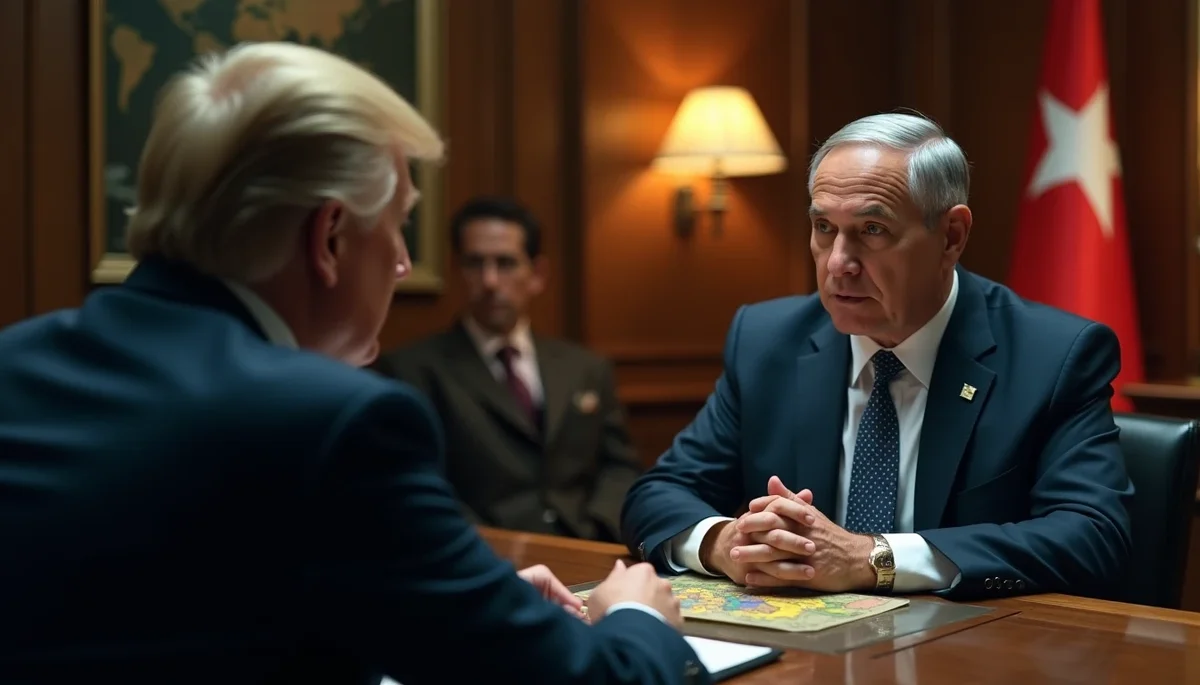
A classified military operation codenamed 'Narnia' has emerged as the centerpiece of Israel's contingency planning against Iran's nuclear program, even as Prime Minister Benjamin Netanyahu prepares to brief President Donald Trump on potential strike scenarios during their upcoming meeting. According to Washington Post reporting, the two leaders began coordinating joint military options during Netanyahu's February White House visit, with Israeli officials expressing mounting concern over any expansion of Tehran's ballistic missile capabilities.
The timing proves significant. NBC News reports that Israeli officials now view accelerated Iranian nuclear development as a threshold requiring 'swift action,' a posture that has intensified following the collapse of Assad's regime in Syria and the subsequent power vacuum across the region. The strategic calculus has shifted dramatically—with Damascus no longer serving as Iran's reliable corridor to Hezbollah, Jerusalem sees a narrowing window to address what it considers an existential threat.
Yet even as Israel contemplates strikes eastward, its northern front shows unexpected progress. Lebanese Prime Minister Nawaf Salam announced Saturday that Hezbollah's disarmament south of the Litani River stands 'only days away from completion,' a development that would fulfill the first phase of the U.S.-brokered ceasefire agreement signed in November. The roadmap envisions five phases extending progressively northward—through the Awali River region, into Beirut's suburbs, across the Bekaa Valley, and finally throughout northern Lebanon. Senior French, American, and Saudi officials met Thursday with Lebanese Army commanders to discuss funding mechanisms, though sources indicate significant doubts remain about whether the army will actively enforce disarmament beyond the southern zone.
The prophetic student of Scripture cannot help but note the convergence of these developments. Isaiah's burden of Damascus finds contemporary resonance as Syria becomes a battlefield between U.S. forces striking Islamic State positions—over 70 targets hit in joint operations with Jordan—and various factions vying for territorial control. The IDF's detention of a suspected ISIS operative in southern Syria underscores how the ancient crossroads of empires remains contested ground. Meanwhile, Turkey's intelligence chief met Saturday with Hamas negotiating team leader Khalil Al-Hayya to discuss advancing the Gaza peace plan's second phase, while U.S. Special Envoy Steve Witkoff confirmed ongoing coordination with Qatar, Turkey, and Egypt to establish what he termed a 'Gaza Board of Peace.'
The financial architecture of the emerging order deserves attention. Coinbase's 2026 Crypto Market Outlook draws parallels between current digital asset markets and the mid-1990s technology boom—a measured assessment that contrasts with more euphoric industry predictions. The report highlights DeFi's narrative revival even as Ethereum slipped below $2,800, suggesting institutional players are positioning for regulatory maturation rather than speculative frenzy. Stablecoin infrastructure and tokenization frameworks continue advancing across major economies, building the technical scaffolding for systems that could eventually facilitate the kind of centralized economic control prophetic texts anticipate.
Energy politics adds another layer to regional dynamics. A major gas deal between Israel and Egypt, celebrated by Netanyahu in a public ceremony with Energy Minister Eli Cohen, has drawn criticism from UN Special Rapporteur Francesca Albanese, who claims it violates international law. Yet the commercial arrangement masks deeper strategic tensions—Cairo and Jerusalem remain far from political alignment despite their energy interdependence. In a parallel development, Israel hosted a trilateral summit with Greece and Cyprus in Jerusalem, establishing a united front against Turkish maritime aggression in the Eastern Mediterranean.
As atmospheric rivers prepare to pummel California with up to 500 millimeters of rainfall over the Sierra Nevada through Christmas, and as seismic activity continues along the San Ramon fault, the natural order itself seems to echo the turbulence of human affairs. Those who understand the times, as the sons of Issachar did, recognize these convergent patterns—military preparations against Persia, the systematic disarmament of Israel's northern adversary, digital financial infrastructure expanding, and nations aligning along ancient prophetic fault lines. The stage continues to be set, and the actors increasingly know their parts.