
The Philippine island of Mindanao jolted awake at 11:02 local time this morning when a magnitude 6.4 earthquake struck 17 kilometers east-southeast of Baculin in Davao region. The shallow tremor, originating just 35 kilometers beneath the surface, sent residents scrambling from buildings and generated immediate tsunami assessments—though authorities quickly confirmed no ocean threat existed. The USGS assigned a green alert level, but the ShakeMap registered intensity VI, strong enough to crack walls and topple unstable structures. Within hours, a secondary M5.5 quake struck 53 kilometers east of Santiago, compounding anxiety across the archipelago's southern reaches.
This Philippine seismic cluster represents just one node in a remarkable 24-hour period of global tectonic activity. The Volcano Discovery network catalogued 709 earthquakes worldwide, including one magnitude 6.0-plus event, six above 5.0, and 43 exceeding magnitude 4.0. From Denali National Park in Alaska, where a M4.5 tremor originated 127 kilometers deep, to Petropavlovsk-Kamchatsky in Russia's Far East and the still-recovering Vanuatu near Port-Vila, the Pacific Ring of Fire continues its relentless demonstration of planetary forces beyond human control. MIT geophysicist Matěj Peč's recent laboratory research offers sobering context: less than 10 percent of an earthquake's energy actually produces ground shaking—the rest dissipates as heat and rock fracturing, meaning what communities feel represents merely a fraction of the forces at work.
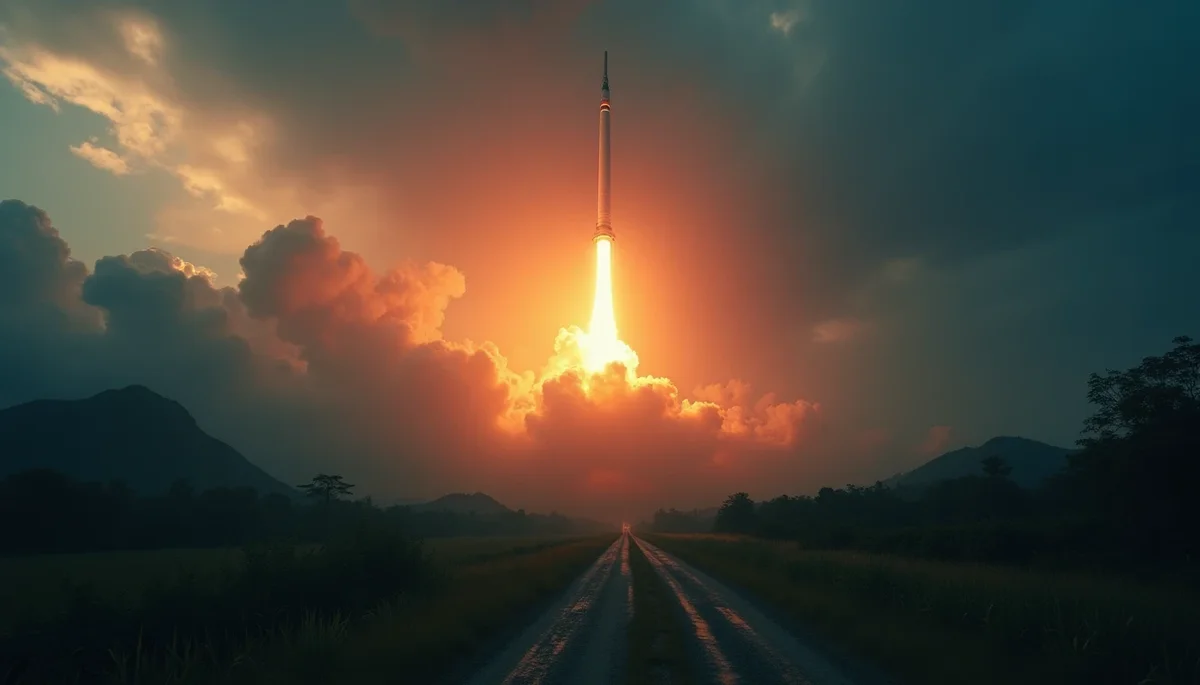
While the earth trembles, North Korea's Kim Jong Un chose this moment to unveil Pyongyang's latest military advancement. State media announced the successful test of a hypersonic missile Sunday, with Kim personally overseeing the launch and declaring the weapon "nuclear-ready." The timing—within 24 hours of the U.S. military operation in Caracas to capture Venezuelan President Nicolas Maduro—appears calculated to signal that Washington's assertive posture in one hemisphere invites challenges in another. North Korean officials branded the United States a "rogue state," rhetoric that carries particular weight as the Korean Peninsula enters what analysts consider an increasingly volatile period.
The financial architecture undergirding global power continues its own transformation. CNBC has declared XRP the standout cryptocurrency trade of 2026, noting the Ripple-backed token surged more than 20 percent in one week to become the third-largest digital asset by market capitalization. The network's focus on banking infrastructure and cross-border payments positions it at the intersection of traditional finance and emerging digital systems. Meanwhile, Senator John Kennedy confirmed the Senate Banking Committee will hold a markup vote on the CLARITY Act next Thursday, January 16—legislation that would finally delineate regulatory boundaries between the SEC and CFTC over cryptocurrency markets. The American Bankers Association has raised alarms about the recently passed GENIUS Act, warning that a loophole allowing stablecoin issuers to indirectly fund payments through crypto exchanges could drain deposits from community banks.
In the Middle East, the paradox of conflict and commerce persists. Israeli-approved aid continues flowing into Gaza even as Hamas maintains financial reserves reportedly worth billions, much of it hidden in the territory's tunnel networks. Iranian protests have now entered their eleventh day, with the death toll reaching at least 36 across 92 cities in 27 provinces. Tehran executed a man accused of spying for Israel's Mossad, signaling the regime's determination to project strength even as 2,076 protesters reportedly sit in detention. Prime Minister Netanyahu, fresh from consultations with President Trump, convened his security cabinet to review intelligence and attack planning amid Hezbollah deployments in Lebanon.
For those who study prophetic patterns, the convergence bears watching: nations in turmoil, the earth itself unstable, financial systems in transformation, and weapons of unprecedented speed entering arsenals. The ancient prophets spoke of a time when "nation shall rise against nation" accompanied by "earthquakes in diverse places"—language that reads less like metaphor with each passing news cycle. What remains certain is that January 7, 2026, offered no shortage of reminders that the foundations—geological, geopolitical, and financial—upon which modern civilization rests are anything but settled.