
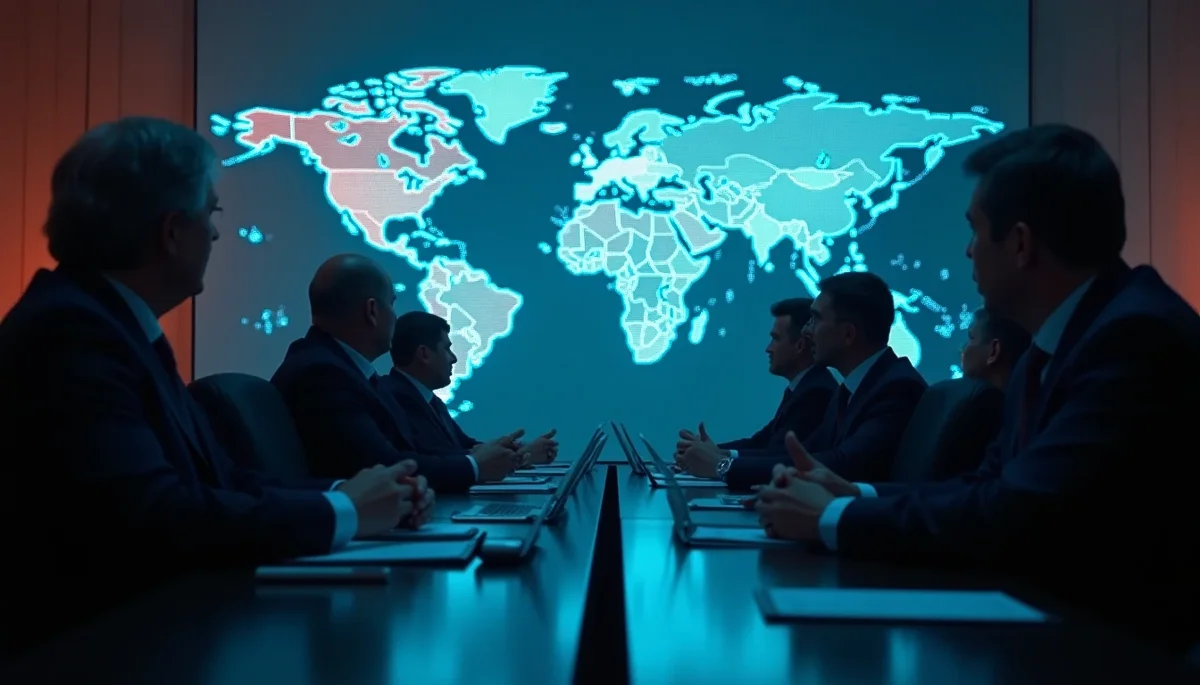
The Trump administration's diplomatic architecture for Gaza enters a critical new phase Friday when Special Envoy Steve Witkoff convenes senior officials from Qatar, Egypt, and Turkey in Miami—notably without Israeli representation at the table. The unusual configuration, confirmed by White House officials Thursday, underscores Washington's delicate balancing act as it attempts to advance the second phase of the ceasefire while Jerusalem remains in what officials there describe as a 'period of waiting.'
President Trump indicated that Prime Minister Benjamin Netanyahu would likely visit him before year's end, suggesting direct bilateral channels remain open even as multilateral talks proceed separately. Sources in the region indicate the Miami format reflects growing frustration among Arab mediators over the pace of implementation, with the ceasefire architecture across multiple fronts described as 'fragile.' Netanyahu, for his part, convened a security briefing Thursday as his government navigates both diplomatic pressures and domestic unrest—hundreds of ultra-Orthodox protesters blocked major highways across Israel following clashes with police in Jerusalem that left ten officers injured.
The financial dimensions of Gaza's future also came into sharper focus this week. Middle East Eye reports that US, Israeli, and UAE officials have discussed utilizing Gaza's offshore natural gas reserves to fund reconstruction—a proposal that would fundamentally reshape the economic calculus of any post-conflict arrangement. Simultaneously, IDF operations have significantly compromised Hamas's financial infrastructure, with Arabic-language outlet Aawsat reporting the organization now struggles to pay its operatives' salaries, a development that could accelerate or complicate ceasefire dynamics depending on internal Hamas politics.
Beyond the negotiating rooms, Israel's military cyber chief Maj. Gen. Aviad Dagan delivered a stark warning Tuesday that resonates with broader prophetic concerns about invisible systems of control. Speaking publicly for the first time about threat levels, Dagan stated that both Israel and the United States face 'unprecedented cyber threats of which the public is largely unaware.' His caution against complacency—'We cannot mislead ourselves into thinking that, because Israel has been strong in cyber defense'—arrives as digital infrastructure increasingly underpins both warfare and commerce.
The convergence of physical and digital battlespaces manifests in troubling ways. Israeli officials now assert that the assassination of MIT nuclear physicist Nuno Loureiro in his Boston-area home this week was carried out by an Iranian operative—a targeted killing on American soil that authorities are investigating for possible connections to a separate shooting at Brown University. The 47-year-old fusion energy researcher's murder represents an escalation in shadow warfare that transcends traditional geographic boundaries.
Meanwhile, the digital financial architecture continues its rapid evolution. PayPal announced its PYUSD stablecoin will fund AI companies through a new partnership, while Brazil's B3 stock exchange unveiled plans for a tokenization platform and settlement stablecoin launching in 2026. SoFi Bank introduced its own dollar-backed stablecoin for business transactions. These developments accelerate what analysts increasingly describe as the infrastructure for comprehensive financial surveillance—systems that, once established, could enable unprecedented monitoring and control of economic activity.
The Brownstone Institute's analysis published Thursday posed the question directly: 'Has Orwell's 1984 Become Reality?' The piece examines how mass surveillance, facial recognition, and digital identity systems have normalized what previous generations would have considered dystopian. For students of biblical prophecy, these parallel tracks—regional conflicts centered on Israel, assassination networks operating globally, and financial systems enabling total transaction visibility—form a recognizable pattern. The prophet Daniel spoke of a time when knowledge would increase and many would run to and fro; we appear to be living in that acceleration.
As diplomats gather in Miami and cyber commanders issue warnings from Jerusalem, the architecture of tomorrow's world takes shape in real time. What bears watching: whether the Gaza talks produce concrete implementation timelines, how Israel responds to the Iranian assassination on US soil, and whether the proliferation of stablecoins creates the interoperable financial infrastructure that would make comprehensive economic surveillance technically feasible. The pieces continue assembling; the picture grows clearer by the day.