
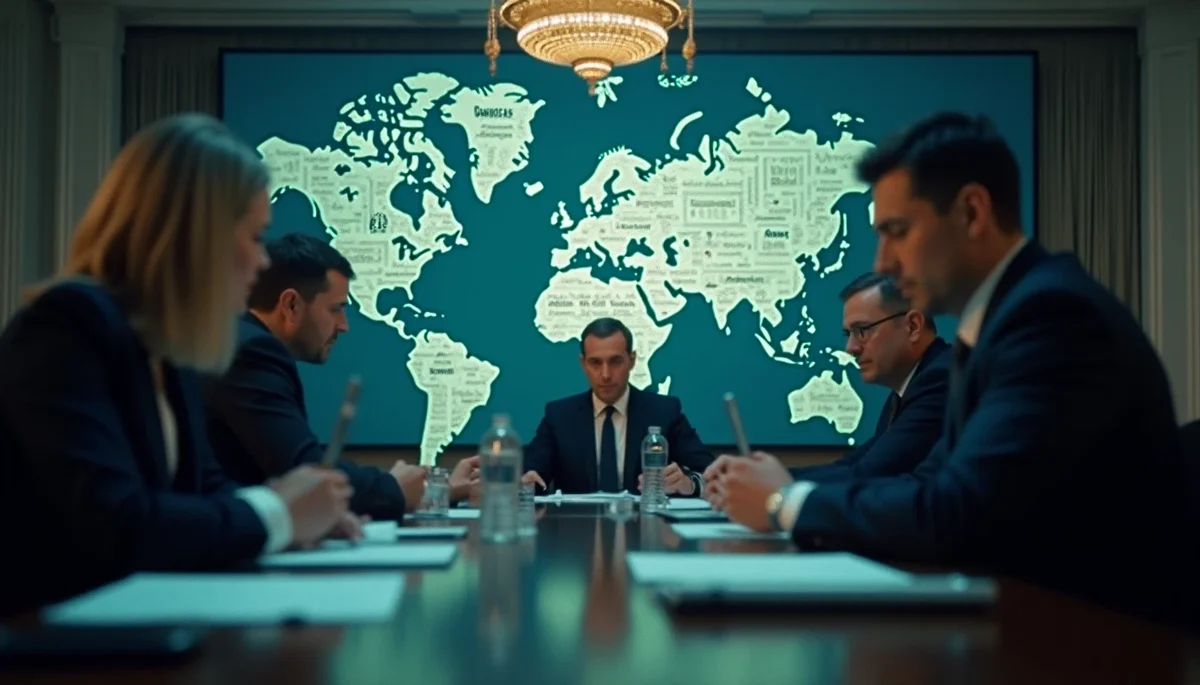
Half of Kyiv's buildings stand without power or heating tonight as former boxing champion and Mayor Vitali Klitschko urges residents to evacuate Ukraine's capital. The grim announcement follows Russia's second-ever deployment of its hypersonic Oreshnik missile, this time striking western Ukraine just 60 kilometers from the Polish border—a deliberate show of force that Moscow frames as retaliation for an alleged assassination plot against President Putin.
The strike on Lvov drew global attention, but the systematic destruction of Ukraine's power infrastructure represents an equally devastating campaign. Klitschko's evacuation call signals a humanitarian crisis deepening in the heart of Europe as winter temperatures plunge. The Kremlin's message is unmistakable: Russia possesses weapons the West cannot intercept, and it will use them near NATO's doorstep.
President Trump responded to the escalating global tensions by declaring the United States is watching Iran closely. 'We will intervene if it starts killing people,' Trump stated, adding that 59 countries have expressed willingness to participate in Gaza operations should Hamas refuse to disarm. The warning comes as South Africa prepares to host joint military exercises with China, Iran, and Russia—a naval war game that threatens to push U.S.-South African relations to their lowest point in history.
South African officials are reportedly attempting to persuade Iran to participate only as an observer rather than an active participant, acknowledging the diplomatic sensitivities. Yet the symbolism of these four nations conducting joint operations in the Atlantic speaks volumes about emerging power blocs. The Trump administration has already signaled its response, seizing a Russian-flagged tanker in Atlantic waters in what analysts describe as a reassertion of American influence over its historical sphere.
Meanwhile, China's Communist Party is sending what advocates call a 'chilling message' to believers worldwide. A new wave of arrests targeting unregistered churches this week underscores Beijing's intensifying crackdown on religious freedom. Corey Jackson of the Luke Alliance described China as 'one of the worst abusers of human rights in the world,' noting the CCP's clear signal that obedience to God will be punished. For students of prophecy, the persecution of the faithful in the world's most populous nation echoes warnings found throughout Scripture about the tribulation facing believers in the last days.
The Pacific Ring of Fire continues its restless activity. A magnitude 5.6 earthquake struck south of the Fiji Islands today, followed by another 5.6 temblor near Vanuatu and a 4.8 quake off Russia's Kamchatka Peninsula. The Philippines' Mayon volcano has built a new lava dome, generating pyroclastic flows as Kilauea and Great Sitkin remain at elevated alert levels. Jesus spoke of earthquakes in diverse places as signs of the times—a pattern that seismologists are documenting with increasing frequency across the Pacific basin.
On the financial front, the cryptocurrency industry approaches a pivotal moment. The Blockchain Association's CEO Summer Mersinger announced that Congress will mark up the long-awaited crypto market structure bill on January 15, describing it as a defining moment for digital asset legislation. South Korea has joined the global push for Bitcoin spot ETFs, targeting a 2026 rollout as part of broader economic reforms. The infrastructure for a transformed global financial system continues to take shape, piece by piece.
Australia faces its own tensions as pro-Palestine demonstrators return to the streets with what observers describe as violent rhetoric, barely a moment after the nation's brief unity following the Bondi massacre. The speed of this resurgence reveals how thin the veneer of social cohesion has become in Western democracies grappling with the Israel-Gaza conflict.
Watch the January 15 crypto markup closely—it may define how digital assets integrate with traditional finance for years to come. Watch Iran's next moves as Trump draws red lines and South Africa courts Tehran. And watch Kyiv, where millions face a frozen winter as the world's attention drifts elsewhere. The convergence of military, economic, and natural upheaval across multiple continents suggests we have entered a season where vigilance is not optional—it is essential.