
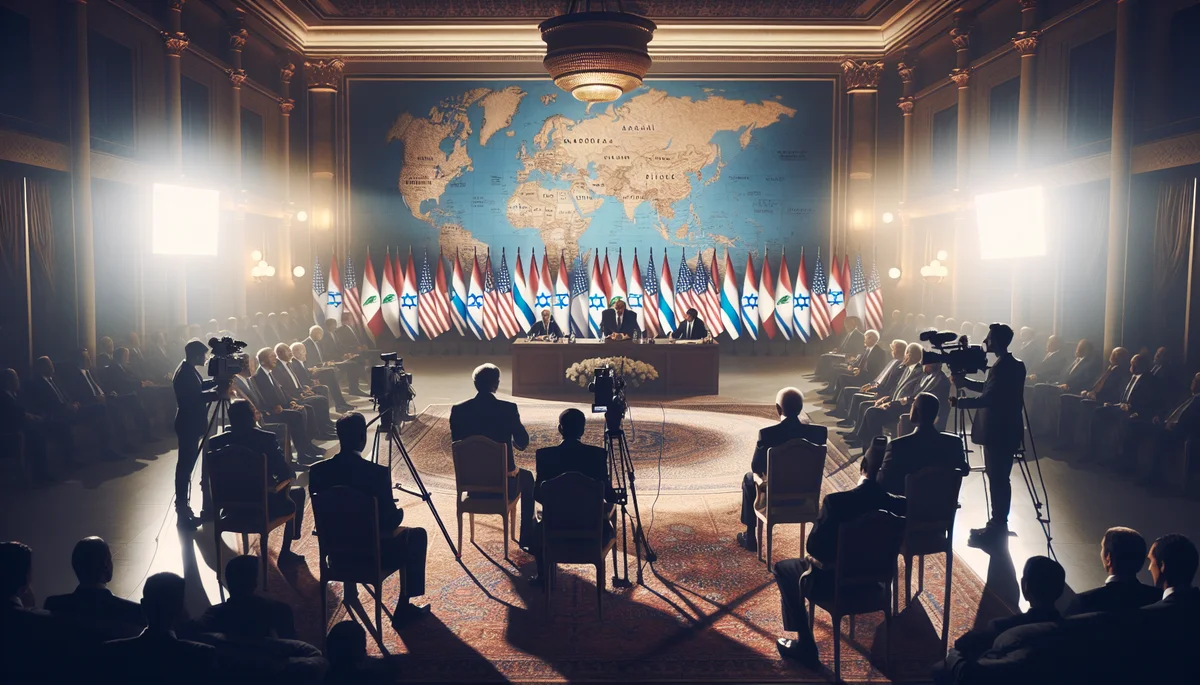
For the first time since 1983, Israeli and Lebanese civilian representatives sat across from one another at the UN peacekeeping force's headquarters in Naqura, marking a diplomatic watershed that would have seemed unthinkable just months ago. Israeli Prime Minister Benjamin Netanyahu's office confirmed Wednesday that the meeting represents an initial attempt to establish a foundation for economic relations and cooperation between the two nations, which have technically remained in a state of war for over four decades.
The talks, held under the framework of a ceasefire monitoring mechanism established following last year's conflict with Hezbollah, saw Lebanon dispatch former ambassador to the United States Simon Karam as its civilian representative—a significant departure from previous military-only delegations. Israel's National Security Council sent its own envoy, signaling both nations' willingness to explore normalized relations despite the absence of formal diplomatic ties. U.S. Special Envoy to the Middle East Morgan Ortagus has been pressing both parties, with IDF Military Intelligence chief Maj. Gen. Shlomi Binder presenting intelligence on Hezbollah's rearmament efforts and the Lebanese army's limited capacity to confront the militia.
Students of biblical prophecy will recognize the profound significance of these developments. The prophet Daniel spoke of a time when 'many shall run to and fro, and knowledge shall be increased' (Daniel 12:4), and we witness today an unprecedented acceleration of diplomatic realignments that previous generations could scarcely imagine. The nations surrounding Israel—long hostile—now engage in direct dialogue, echoing the complex peace arrangements described in prophetic literature that precede climactic events.
Meanwhile, Israel announced it will reopen the critical Rafah crossing between Gaza and Egypt within days, allowing Palestinians to exit the territory for the first time since the crossing's closure. The Israeli military coordination body Cogat stated that departures will be 'facilitated through coordination with Egypt, following security approval by Israel and under the supervision of the European Union mission.' Hamas simultaneously announced it would hand over the body of an Israeli hostage, in what appears to be a calculated gesture amid ongoing tensions. These developments follow the UN Security Council's unanimous approval of President Trump's 'Board of Peace' plan, which establishes a framework for international oversight of Gaza's future.
The regional picture grows more complex as Turkey openly pushes for closer ties with Iran despite mounting international sanctions. Turkish officials have called for expanded diplomatic and trade relations with Tehran, as both nations seek to bolster their influence across the Middle East while maintaining adversarial postures toward Israel. This emerging axis recalls the ancient coalition described in Ezekiel 38, where Persia (modern Iran) and territories associated with modern Turkey align in opposition to Israel—a pattern that scholars have long anticipated.
On the technological front, the abandonment of AI safety protocols by major developers has raised alarm bells among researchers. As autonomous systems increasingly penetrate critical infrastructure—from legal proceedings now threatened by deepfake evidence to biometric age verification spreading across global retail—the absence of meaningful guardrails presents what experts term an 'existential risk.' Companies like Reality Defender and Incode Technologies are racing to develop countermeasures against synthetic media, but the arms race between AI-driven attacks and defenses intensifies daily.
The convergence of these threads—diplomatic breakthroughs in the Levant, great power realignment, and the unchecked advance of autonomous technologies—presents a picture of accelerating change that demands careful observation. Whether these developments represent steps toward genuine peace or merely the calm before prophesied storms, the watchful student of history and Scripture recognizes we stand at a pivotal moment. The ancient words of Jesus in Matthew 24 counsel vigilance: 'Watch therefore, for you do not know what hour your Lord is coming.' Today's events suggest that hour draws nearer.