
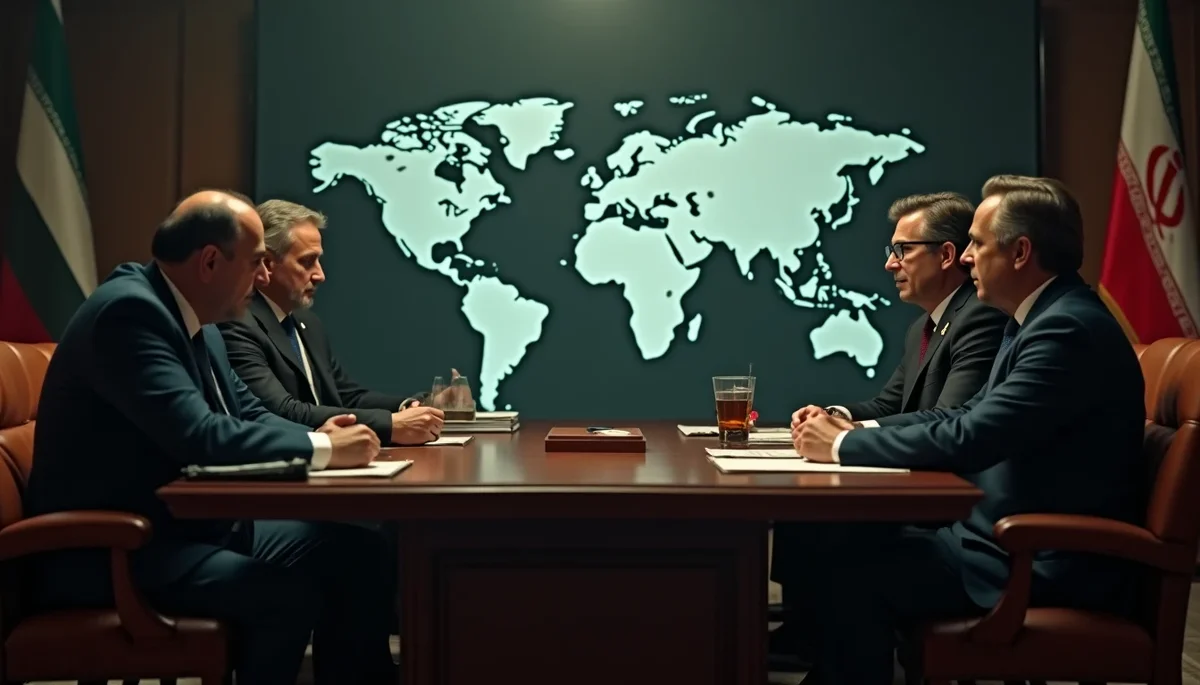
Iranian President Masoud Pezeshkian's declaration that Tehran is engaged in 'full-fledged war with America, Israel, and Europe' marks a significant escalation in rhetoric as the year draws to a close. Speaking amid renewed international pressure, Pezeshkian warned that any future attacks on Iranian territory would receive 'a harsher response,' setting the stage for what promises to be a consequential summit between Israeli Prime Minister Benjamin Netanyahu and President Donald Trump in Florida on Monday. Netanyahu is expected to present intelligence on Iran's efforts to reconstitute its missile program and seek American authorization for potential military action—a request that could reshape the strategic calculus across the Middle East.
The timing of Iran's bellicose posture coincides with a significant counterterrorism operation in Italy, where authorities arrested nine individuals on December 27 for allegedly funneling money to Hamas through charitable organizations. Among those detained is Mohammad Hannoun, president of the Palestinian Association in Italy, in what Interior Minister Matteo Piantedosi described as a coordinated operation targeting terrorist financing networks operating under humanitarian cover. This development underscores how the Gaza conflict has metastasized beyond the Middle East, with European security services now actively dismantling support infrastructure that sustained Hamas operations.
The intersection of these events—Iran's war footing, European counterterrorism actions, and the imminent Netanyahu-Trump summit—reveals the increasingly interconnected nature of regional conflicts. Students of biblical prophecy will recognize familiar patterns: the ancient lands of Persia positioning against Israel, Rome once again playing a pivotal role in matters affecting Jerusalem, and the gathering of nations around decisions that will determine war or peace. The prophet Ezekiel spoke of a day when Persia would align against Israel; while we must be careful not to force current events into prophetic frameworks, the directional movement of these ancient powers toward confrontation is unmistakable.
Meanwhile, the situation in Gaza continues to grind forward with grim regularity. Israeli forces killed a Palestinian in Jabalia as military operations persist, while Netanyahu has reportedly indicated that any Gaza stabilization plan will not advance until the last hostage's remains are returned to Israel. The human cost continues to mount: Dr. Hussam Abu Safiya, seized from a Gaza hospital one year ago, remains in Israeli detention, his case emblematic of the broader humanitarian catastrophe unfolding in the territory. A new report from the Palestinian Journalists Syndicate documents what it describes as systematic Israeli targeting of journalists' families, expanding the scope of alleged violations beyond direct attacks.
In the West Bank, tensions flared on multiple fronts. Israeli settlers attacked the Al-Malih community in the northern Jordan Valley, while the IDF imposed a curfew on a town following a deadly ramming-stabbing attack in northern Israel that killed two people. An Israeli reservist was released to house arrest after being filmed running an ATV over a praying Palestinian—an incident the IDF called severe enough to warrant immediate termination of his military service. In Jerusalem, protests marking the fifth anniversary of settler activist Ahuvia Sandak's death turned violent, with two police officers injured after demonstrators allegedly threw stones.
The earth itself seems restless as these human dramas unfold. A magnitude 6.6 earthquake struck 31 kilometers east-southeast of Yilan, Taiwan, while Alaska experienced multiple seismic events including a 4.6 magnitude tremor southwest of Atka. These natural phenomena, occurring against a backdrop of geopolitical instability, remind observers that the 'birth pains' Jesus described in Matthew 24 encompass both human conflict and natural upheaval—not as definitive signs of imminent return, but as characteristic features of an age groaning toward resolution.
As 2025 closes, the convergence of Iranian aggression, European counterterrorism operations, and the Netanyahu-Trump summit demands close attention. The decisions made in the coming days—particularly regarding Iran's nuclear and missile ambitions—may well determine whether the region slides toward broader conflict or finds temporary equilibrium. For those watching with prophetic awareness, these are not random events but threads in a tapestry whose final pattern, while not yet visible, is being woven before our eyes.