
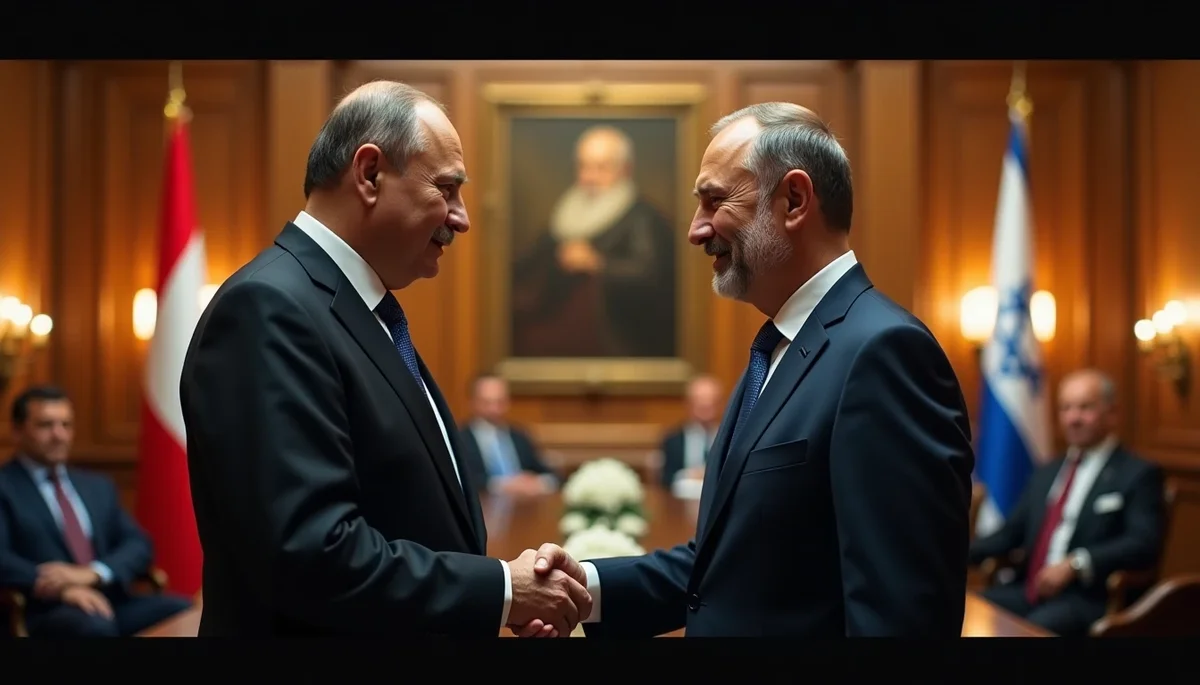
Prime Minister Benjamin Netanyahu stood beside Energy Minister Eli Cohen on Wednesday to announce what he called Israel's 'largest ever' natural gas agreement—a landmark $34.7 billion deal with Egypt that signals a dramatic reshaping of Middle Eastern energy politics. The fifteen-year agreement, valued at NIS 112 billion, will channel approximately NIS 58 billion directly into Israeli state coffers while cementing economic ties between two nations that signed their historic peace treaty in 1979.
The timing proves significant. As Israel strengthens its economic partnership with Egypt, a parallel development unfolds along a different axis entirely. Russia and Iran continue accelerating their strategic alliance, with the completion of the Rasht-Astara railway line enabling uninterrupted freight transport from Russia to the Persian Gulf. Tehran-based political analyst Mohammad Khatibi notes the corridor's strategic value: 'Unlike maritime routes, land corridors through Iran, Azerbaijan, and Russia cannot be interdicted by Western navies.' This infrastructure represents more than commerce—it embodies a deliberate de-dollarization strategy and the construction of economic networks beyond Western reach.
For students of biblical prophecy, these parallel developments merit close attention. The ancient prophets spoke extensively of alliances forming in the latter days—Ezekiel's oracle concerning Gog and Magog specifically identifies Persia (modern Iran) alongside the northern power many scholars associate with Russia. Meanwhile, Egypt's deepening economic integration with Israel reflects a different trajectory entirely, one of pragmatic cooperation that defies the regional hostility characterizing much of the past century.
Germany adds another dimension to Israel's strategic positioning, with the Israeli Defense Ministry announcing Thursday an additional $3.1 billion expansion to their Arrow 3 missile defense agreement. This brings Germany's total investment in Israeli defense systems to approximately $6.5 billion, with both nations agreeing to 'significantly increase the production rate of Arrow 3 interceptors and launchers.' The timing—as Iran's cyber capabilities demonstrated fresh reach by hacking former Prime Minister Naftali Bennett's phone—underscores the escalating technological dimension of regional tensions.
Across the Atlantic, unusual weather patterns challenge prevailing narratives. The U.S. East Coast experiences its snowiest start in nearly two decades, prompting renewed debate over climate projections even as the UN's COP30 conference in Belém, Brazil, concluded last month with what observers describe as increasingly religious framing of environmental concerns. The convergence of climate activism with spiritual language at the United Nations represents a phenomenon worth monitoring—the elevation of creation care into something approaching worship, a subtle shift that biblical scholars note inverts the proper order established in Genesis.
In the digital realm, Russia's State Duma Committee Chairman Anatoly Aksakov declared definitively that cryptocurrencies 'will never become money' in Russia, insisting all payments must occur in rubles. This stance contrasts sharply with the crypto-friendly signals emerging from Washington, where Wednesday's Senate Banking Committee meeting generated cautious optimism about forthcoming market structure legislation. The divergence illustrates how digital currency policy increasingly reflects broader geopolitical alignments.
The Sydney Jewish community, still reeling from the Hanukkah terror attack, received Israeli trauma experts within 48 hours of the incident—a deployment reflecting both the global reach of antisemitic violence and Israel's commitment to diaspora communities. British police, meanwhile, arrested protesters chanting 'intifada' slogans, signaling tougher enforcement following rising concerns about incitement.
What emerges from this week's developments is a world increasingly sorted into competing blocs—economic, military, and ideological. The Israel-Egypt energy partnership represents pragmatic alignment based on mutual interest, while the Russia-Iran corridor embodies deliberate construction of alternative systems. For those watching prophetic patterns unfold, the architecture of future conflict and cooperation grows more visible by the day.