
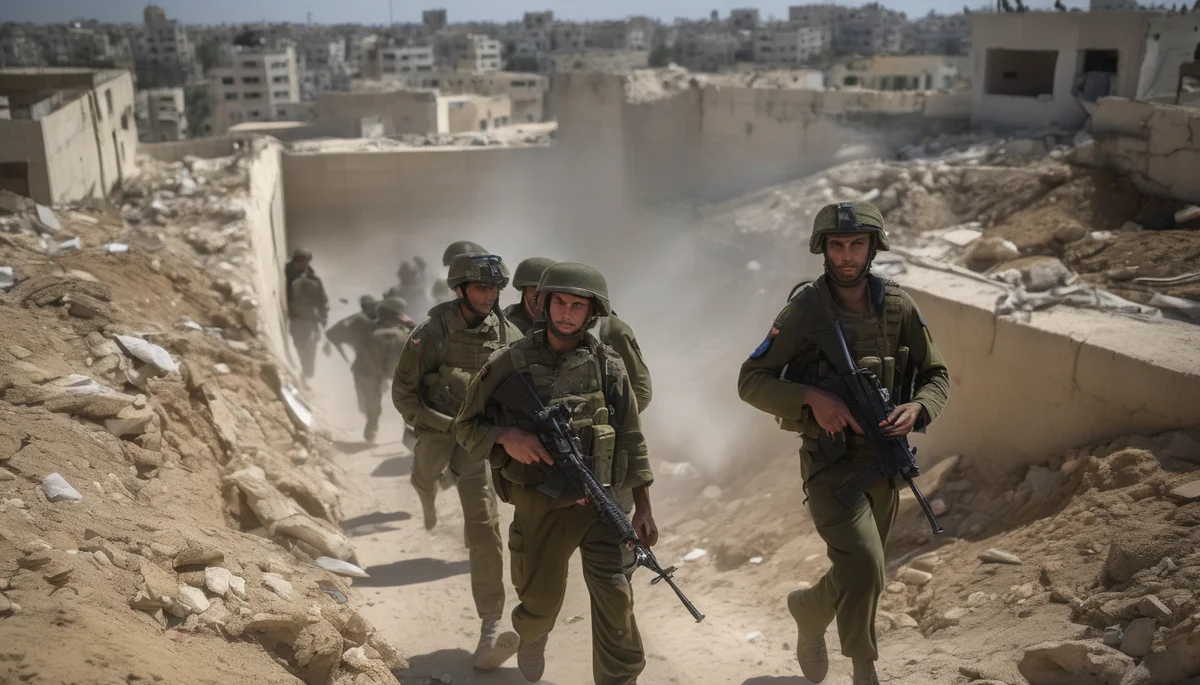
The fragile ceasefire in Gaza suffered another significant blow Wednesday when terrorists emerged from a tunnel in eastern Rafah and opened fire on Golani reconnaissance forces, wounding four Israeli soldiers—one seriously and three moderately. The attack underscores the volatile reality on the ground even as diplomatic efforts intensify to stabilize the region.
The wounded soldiers were evacuated for treatment, and the Israel Defense Forces confirmed their families have been notified. This incident arrives amid what Israeli officials describe as repeated Hamas violations of the U.S.-brokered ceasefire, raising questions about whether the agreement can hold through its current phase. Meanwhile, Israeli forensic experts at the National Forensic Institute in Tel Aviv work through the night to identify remains handed over by Hamas and Palestinian Islamic Jihad, who claim the body belongs to one of the last two deceased hostages held in Gaza. The grim task of identification continues as families await answers that have been months in coming.
Against this backdrop of violence and grief, a dramatic diplomatic shift is taking shape. Israel announced Wednesday that the Rafah crossing with Egypt will partially reopen—but exclusively for Palestinians seeking to exit the war-torn territory. This one-way arrangement signals the beginning of Phase 2 of President Trump's Gaza peace plan, though it has already angered Egyptian officials and raised concerns about the humanitarian implications of such a policy. UN Secretary-General António Guterres added his voice to the criticism, declaring Israel's Gaza operation "fundamentally wrong" and suggesting it may involve war crimes.
President Trump himself has applied unexpected pressure on Prime Minister Netanyahu, reprimanding him over military operations in the Syrian Golan Heights town of Beit Jinn. Trump's message was unambiguous: "It is very important that Israel maintain a strong and true" commitment to diplomatic solutions. The appointment of mission heads by both sides and Lebanon's expressed willingness to engage in political negotiations could potentially halt what observers describe as a stampede toward military confrontation with Hezbollah. For students of biblical prophecy, the convergence of tensions involving Israel, Lebanon, Syria, and Gaza echoes ancient patterns—the prophet Ezekiel spoke of a time when Israel would face threats from multiple fronts, a scenario that seems increasingly relevant as regional alliances shift and fracture.
Beyond the Middle East, the earth itself continues its restless activity. The USGS recorded 485 earthquakes worldwide in the past 24 hours, including 42 events of magnitude 4.0 or greater. A magnitude 5.3 quake struck near El Morro, Mexico, at a depth of 62 kilometers, while dual events along the Pacific-Antarctic Ridge registered magnitudes of 5.5 and 5.1. In an unusual occurrence for the region, a 3.4 magnitude earthquake rattled Warton in the United Kingdom, generating over 270 felt reports from startled residents unaccustomed to seismic activity. While none of these events caused significant damage, the cumulative pattern of global seismicity remains a metric that researchers—and those watching for signs of the times—continue to monitor closely.
In the technology sphere, Israel's Quantum Computing Center in Tel Aviv marked a milestone with the deployment of Qolab's first scalable superconducting qubit device outside its home laboratory in Wisconsin. The system, developed under the guidance of Nobel Laureate John M. Martinis, represents a new generation of robust quantum hardware designed for research scientists—a reminder that even amid regional conflict, Israel remains at the forefront of transformative technologies.
As December unfolds, the threads connecting diplomatic brinkmanship, humanitarian crisis, and natural phenomena weave an increasingly complex tapestry. The coming days will reveal whether Trump's intervention can genuinely redirect Israeli-Lebanese tensions toward negotiation, whether the Rafah crossing arrangement advances or undermines peace prospects, and whether the families of hostages will finally receive the closure they desperately seek. In times such as these, the ancient words of the prophets feel less like distant history and more like a lens through which to understand an uncertain present.