
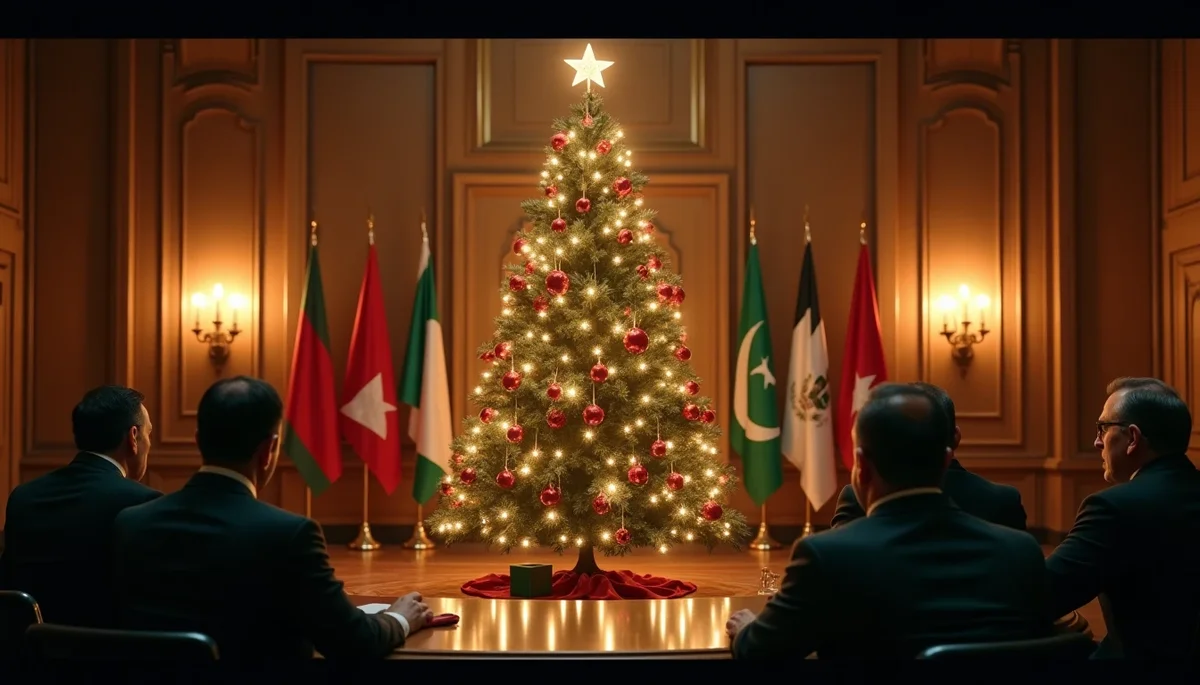
The fragile ceasefire in Gaza has reached what Qatar's Prime Minister describes as a 'critical juncture,' even as Bethlehem's Christmas tree illuminates the night sky for the first time in two years—a poignant symbol of hope emerging from the shadow of conflict. The juxtaposition of these developments on December 6, 2025, captures the precarious balance between war and peace that defines this historic moment in the Holy Land.
Qatar and Egypt, the principal guarantors of the Gaza ceasefire, issued urgent calls Saturday for the immediate withdrawal of Israeli troops and the deployment of an international stabilization force. Speaking at the Doha Forum, officials emphasized that these measures were explicitly outlined in the US- and UN-backed peace plan that brought the fighting to a fragile halt in October. Turkish Foreign Minister Hakan Fidan added complexity to the negotiations, arguing that a credible Palestinian civil administration and vetted police force must be established before any Hamas disarmament can proceed. The diplomatic maneuvering underscores how far the parties remain from a durable resolution.
Meanwhile, Arab and Muslim-majority nations have raised alarm over Israel's stated plan to open the Rafah border crossing for exit only—allowing Palestinians to leave Gaza but blocking their return and preventing humanitarian aid from entering. Foreign ministers from eight nations slammed what they characterized as Israel's breach of ceasefire terms, accusing Jerusalem of pursuing policies designed to 'displace Palestinian people from their land.' The accusation gained additional weight as Syrian President Ahmed al-Sharaa, speaking in Doha, accused Israel of 'fighting ghosts' and exploiting the October 7 attacks to advance territorial ambitions.
Against this backdrop of diplomatic tension, Bethlehem offered a moment of spiritual significance that resonates deeply with biblical history. The giant Christmas tree in Manger Square, standing before the historic Church of the Nativity where tradition holds Christ was born, blazed with light for the first time since the war began. 'It's been a bad two years of silence,' local Christians remarked, their words carrying the weight of communities caught between ancient faith and modern conflict. For students of biblical prophecy, the restoration of celebration in Bethlehem—even amid ongoing strife—recalls the prophet Isaiah's vision of light shining in darkness, though the complete fulfillment of peace in the Holy Land remains elusive.
The theological dimensions of current events extend beyond Bethlehem's celebration. Scholars continue to examine what some interpret as the waning of 'the times of the Gentiles'—a biblical concept describing the era of non-Jewish dominion over Jerusalem and Israel. This framework, drawn from Luke 21:24 and referenced in prophetic literature, suggests that Israel's modern restoration represents a pivotal shift in God's prophetic timeline. Whether one accepts such interpretations or not, the undeniable reality is that Israel's position among nations—and the international community's response to it—remains the defining geopolitical question of our era.
German Chancellor Friedrich Merz departed Saturday for his first official visits to Israel and Jordan since taking office in May, signaling Europe's continued engagement despite the Trump administration's newly released 'America First' national security strategy. That document, which outlines reduced US involvement abroad, has prompted questions about Washington's long-term commitment to Middle East peace processes. The Jerusalem Post analysis suggests the White House will not welcome renewed conflict between Israel and Hamas, Hezbollah, or Iran—but the mechanisms for preventing such escalation remain unclear.
As the sun sets on another day in the Holy Land, the Christmas lights of Bethlehem flicker against the darkness while diplomats in Doha debate the terms of a peace that remains maddeningly out of reach. The ceasefire holds, but barely. What observers should watch in the coming days is whether the international community can translate Qatar and Egypt's calls into concrete action—or whether the 600-plus reported violations since October signal the beginning of the end for this fragile truce. History teaches that in this land, the distance between celebration and catastrophe is measured in hours, not years.