
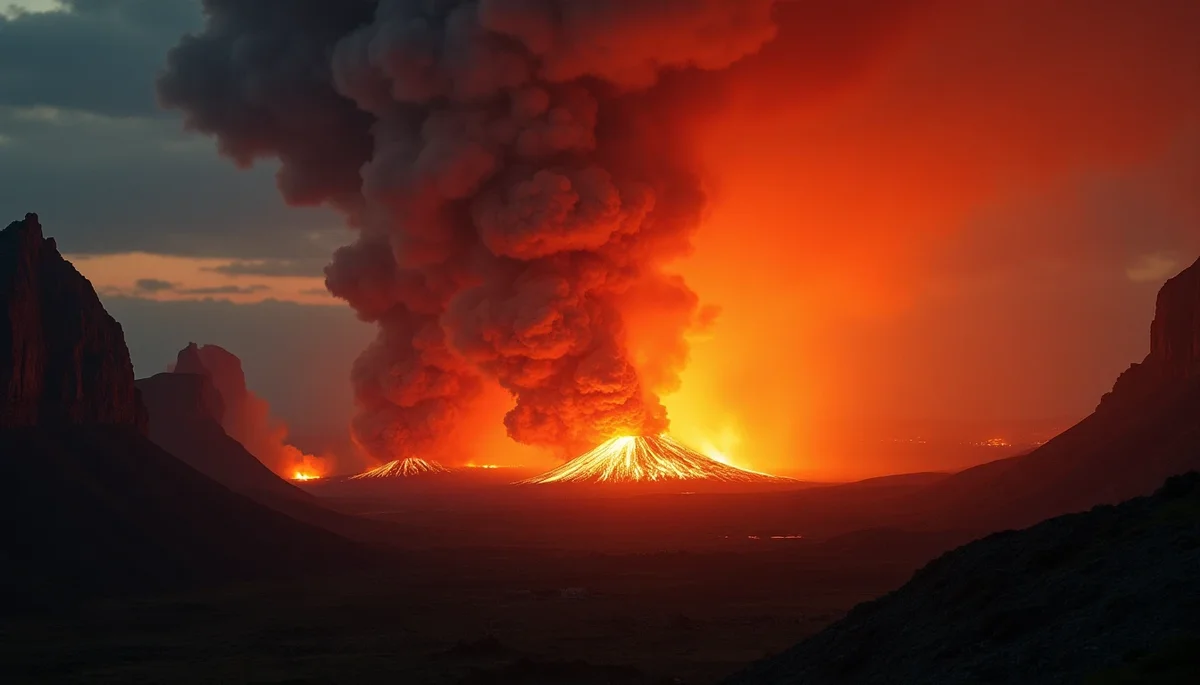
A remarkable surge in volcanic activity stretches across the Pacific Ring of Fire this week, with sixteen volcanoes displaying elevated unrest from Kamchatka to Indonesia. The Smithsonian's Global Volcanism Program reports that Sheveluch volcano in Russia's Far East continues ejecting ash plumes reaching 20,000 feet, while Indonesia's Bur ni Telong has entered a new eruptive phase—the first significant activity at that stratovolcano in years. Meanwhile, Krakatau, Popocatépetl, and Guatemala's Fuego maintain their restless vigil, reminding populations across three continents that the earth's crust remains anything but settled.
The Kamchatkan Volcanic Eruption Response Team confirms that active lava flows continue on Krasheninnikov's northeastern flank, with thermal anomalies visible daily in satellite imagery. Aviation color codes remain at Orange across multiple Russian volcanoes—the second-highest alert level. Japan's Kusatsu-Shiranesan adds to the regional concern, with the Japan Meteorological Agency reporting continued unrest through January 7. For those who track such patterns, the simultaneous activation across the Pacific basin carries echoes of biblical passages describing the earth groaning in travail.
Yet nature's tremors pale against the humanitarian catastrophe unfolding in Gaza, where cancer patients face what doctors describe as slow-motion death sentences. Medical professionals report that cancer-related deaths have tripled since Israel's military operations began, as restrictions block patients from leaving the territory and severely limit chemotherapy drug imports. Hani Naim, who has lived with cancer for six years and once received treatment in Jerusalem and the West Bank, now finds himself trapped. 'I used to receive treatment,' he told Al Jazeera. 'Today, I cannot access any treatment.' The systematic denial of medical evacuation permits has transformed manageable diagnoses into terminal ones.
The ceasefire between Israel and Hamas continues to fray at the edges. The IDF conducted targeted strikes on Hamas positions in northern and southern Gaza Thursday, responding to what military officials characterized as a rocket launch violation. Ambassador Mike Huckabee, speaking to KAN News, confirmed that Israel will make independent decisions regarding any renewed strikes on Iran, though coordination with Washington continues. 'What they will do, what the United States will do, and what Israel will do will be decisions that each nation makes independently,' Huckabee stated, signaling the complex diplomatic dance underway.
Amid the geopolitical turbulence, an ancient pattern of scapegoating resurfaces. Even as Venezuela reels from the U.S. military operation that captured President Nicolás Maduro, antisemitic conspiracy theories have emerged blaming Israel as the hidden hand behind regime change in Caracas. This reflexive attribution—casting the Jewish state as villain regardless of evidence—represents what observers call 'antisemitic delusion,' a phenomenon that transcends political boundaries and rational analysis.
Christian communities face their own existential pressures. Nigeria and Syria now host some of the world's most persecuted believers, with over 380 million Christians globally facing intense hostility according to religious freedom monitors. The burning of a Christmas tree in Hama, Syria prompted protests in Damascus last month, a stark reminder that the fall of one authoritarian regime does not guarantee safety for religious minorities.
The digital financial realm offers no refuge from volatility. BitMEX analysts declared this week that October's massive crypto crash—which erased $20 billion in market value over 48 hours—marked the definitive end of the 'easy yield' era. The liquidation spiral left market makers exposed, fundamentally reshaping how traders approach risk. Meanwhile, stablecoin transactions soared to $33 trillion in 2025, a 72% increase driven by regulatory clarity and institutional adoption.
As volcanoes smoke and ceasefires crumble, the convergence of natural upheaval and human conflict presents a sobering picture. Watch the Kamchatka peninsula, where multiple volcanoes remain on elevated alert. Watch Gaza's hospitals, where the absence of medicine writes death certificates in slow motion. And watch Tehran, where the regime's fate may determine whether the Middle East finds equilibrium or descends further into chaos. The earth shakes; the nations rage. The pattern is ancient, even if its particulars are painfully contemporary.