
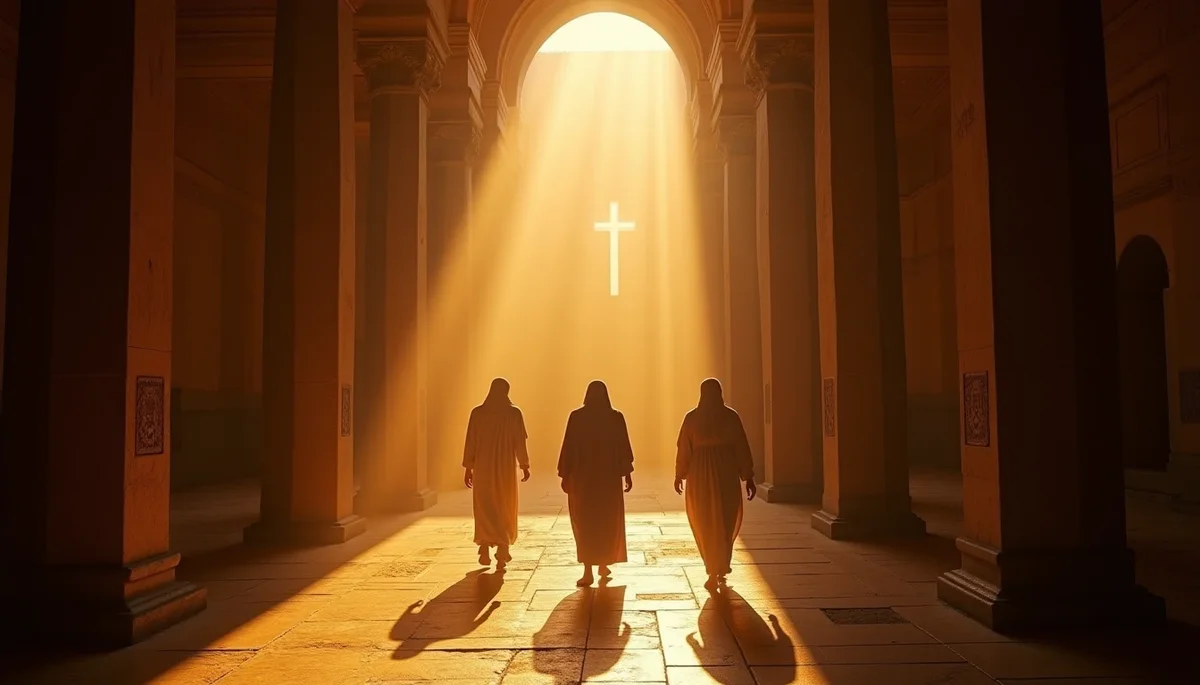
Egyptian Christians are increasingly turning to underground safe houses as religious persecution intensifies across the country, according to reports emerging this week from advocacy organizations monitoring the situation. The development underscores a troubling pattern of discrimination and violence that has forced vulnerable believers into hiding—a reality that echoes the early church's experience of seeking refuge from hostile authorities.
Worthy News reports that attacks against Coptic communities have persisted despite official denials from Cairo, with families relocating to secret locations coordinated by local church networks. The persecution comes at a particularly fraught moment for Egypt, which this week found itself defending a massive $35 billion natural gas deal with Israel as 'purely commercial' amid criticism from regional observers. Egypt's State Information Service emphasized the agreement involves private energy companies including Chevron and carries 'no political dimensions'—a claim met with skepticism given the ongoing humanitarian crisis in Gaza.
The convergence of Christian persecution and high-stakes diplomacy in Egypt reflects broader regional dynamics that demand careful attention. As the prophet Jeremiah reminded ancient Israel, 'Seek the welfare of the city where I have sent you into exile' (Jeremiah 29:7)—counsel that today's Egyptian believers must weigh against their immediate safety.
Meanwhile, Washington's confrontation with international institutions intensified Thursday as Secretary of State Marco Rubio announced sanctions against two additional International Criminal Court judges. The targeted jurists—Gocha Lordkipanidze of Georgia and Erdenebalsuren Damdin of Mongolia—voted Monday to reject Israel's appeal against the Gaza war crimes investigation. This marks the second round of ICC sanctions under the Trump administration, signaling an unprecedented willingness to penalize international judicial bodies. The court has repeatedly condemned U.S. measures while continuing its investigation into alleged violations during the Gaza conflict.
Diplomatic efforts continue despite these tensions. A White House official confirmed that special envoy Steve Witkoff will host senior officials from Qatar, Egypt, and Turkey in Miami on Friday to discuss the next phase of Gaza ceasefire implementation. The talks focus on Stage Two provisions requiring Israeli withdrawal and establishment of an interim governing authority—negotiations that have stalled repeatedly over fundamental disagreements about Gaza's future administration.
In Southeast Asia, Laos launched its national digital identity system on December 17, joining an accelerating global movement toward biometric identification infrastructure. The Ministry of Public Security confirmed citizens can now apply for digital ID cards incorporating facial recognition technology. Prove, a U.S.-based identity verification company, simultaneously announced its ProveX network—a digital trust exchange enabling enterprises to share verified customer credentials. These parallel developments in government and private-sector identity systems warrant monitoring, as Scripture repeatedly warns believers to exercise discernment regarding systems that could enable comprehensive tracking of human activity.
Nature itself provided a stark reminder of human vulnerability this week as researchers mapped over 700 landslides and avalanches triggered by the December 6 magnitude 7.0 earthquake beneath Alaska's Hubbard Glacier. The seismic event, centered 89 kilometers north of Yakutat, caused widespread ground failures across both Alaska and Canada—the largest concentration of slope failures occurring within the St. Elias Mountains. Such geological upheaval recalls Christ's words in Luke 21 about 'earthquakes in various places' as characteristic of the age preceding His return.
Christian leaders are responding to rising global tensions with renewed calls for solidarity. The International Christian Embassy Jerusalem USA unveiled its Christian Declaration Against Antisemitism on Tuesday, uniting believers across denominational lines to publicly oppose hatred targeting Jewish communities. The initiative follows the tragic Bondi Beach shooting in Sydney, where gunmen killed more than 15 people at a Jewish community gathering—an attack that has galvanized interfaith cooperation between Christians and Jews.
As believers navigate these converging pressures—persecution driving Christians underground, diplomatic structures fracturing, digital surveillance expanding, and natural disasters intensifying—the ancient counsel remains timely: 'Watch and pray.' The coming weeks will reveal whether Friday's Miami talks yield progress on Gaza, whether Egypt's Christians find lasting refuge, and whether international institutions can withstand Washington's sustained pressure. These developments merit sustained attention from those seeking to understand the times.