
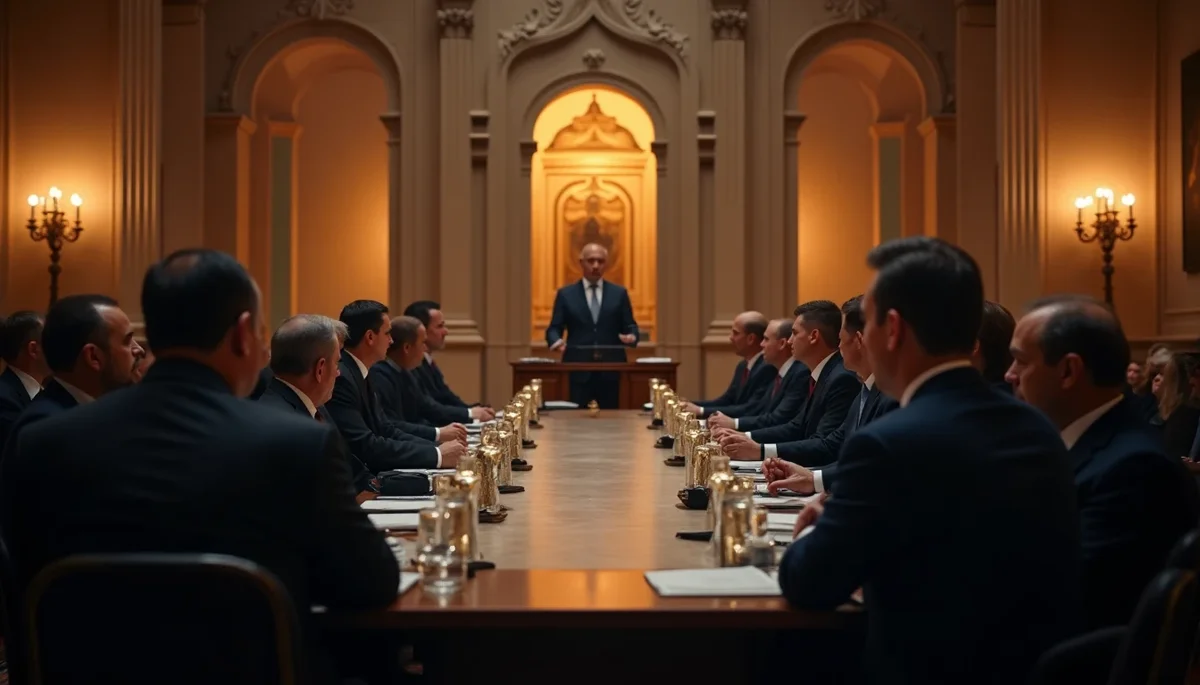
On this Christmas morning, the ancient streets of Jerusalem pulse with a tension that transcends the holiday. The dismissal of Jerusalem District Police Commander Amir Arzani—fired by National Security Minister Itamar Ben-Gvir for refusing to ease restrictions on Jewish worshippers at Temple Mount—signals a deepening crisis over the world's most contested religious site. Arzani has announced he will boycott his successor's January 4 promotion ceremony, a public rebuke that underscores the fractures within Israel's security establishment over policies at the sacred compound.
The Temple Mount controversy unfolds against a backdrop of expanding Israeli territorial claims. The security cabinet's approval of 19 new settlements in the occupied West Bank has drawn swift condemnation from Britain, Canada, Germany, and other G7 nations—with the notable exception of the United States. Foreign Minister Gideon Sa'ar has dismissed the international criticism as 'discriminatory against Jews,' declaring that 'foreign governments will not restrict the right of Jews to live in the land of Israel.' The diplomatic isolation deepens even as IDF forces conduct targeted strikes against Hezbollah operatives in southern Lebanon, with Israeli UAVs hitting targets near the village of Houla in what appears to be a systematic campaign despite the fragile regional ceasefire.
Meanwhile, a parallel transformation reshapes the information landscape across Western democracies. Secretary of State Marco Rubio announced Tuesday that the United States is sanctioning five European activists—including a former EU commissioner—whom the administration labels 'agents of the global censorship-industrial complex.' The sanctioned individuals had been working to combat antisemitic disinformation, yet Washington frames their activities as threats to free expression. This move arrives as Australia implements sweeping online speech restrictions, with politicians pivoting to police digital discourse amid what critics describe as 'failing multiculturalism' and rising Islamist threats.
The speech control debate extends to Congress, where the TAKE IT DOWN Act—sponsored by Senate Commerce Chair Ted Cruz—has drawn warnings from digital rights advocates. The Electronic Frontier Foundation cautions that while the bill aims to protect victims, it provides 'powerful people a new legal tool to force online platforms to remove lawful speech they simply don't like.' The pattern emerges clearly: governments across the ideological spectrum are racing to control digital discourse, each claiming necessity while expanding surveillance infrastructure.
Analysts tracking these developments point to what some call 'The Great Reset in motion'—a framework suggesting that recent global disruptions, from pandemic responses to energy crises, represent not chaos but coordinated transformation. Russia's major stock exchanges announced readiness to launch cryptocurrency trading under the Central Bank's new regulatory framework, signaling that even nations outside the Western financial system are building parallel digital infrastructure. Bitcoin's 30% decline from its $126,000 all-time high to approximately $87,370 has sparked comparisons to the December 2021 crash, with some experts predicting further drops to $70,000.
For those who study the intersection of faith and culture, Christmas 2025 presents a striking tableau. As Peter Oborne reports from Jerusalem, 'the whole of Christianity is under attack here'—a sentiment echoed by the congressional delegation that traveled 5,000 miles to Nigeria, where Representative Bill Huizenga delivered a message to leaders of a nation where Christians face severe persecution: 'We're watching.' The biblical lands remain the crucible where ancient promises and modern politics collide.
What emerges from this Christmas Day snapshot is a world in active reorganization—territorial, digital, and spiritual. The Temple Mount tensions, the speech control regimes, the cryptocurrency pivots, and the persecution of believers form a constellation that prophetic observers recognize from ancient texts. As one commentator notes, reflecting on the season: 'God will keep every aspect of His word.' Whether that brings comfort or urgency depends entirely on where one stands when the transformation completes.