
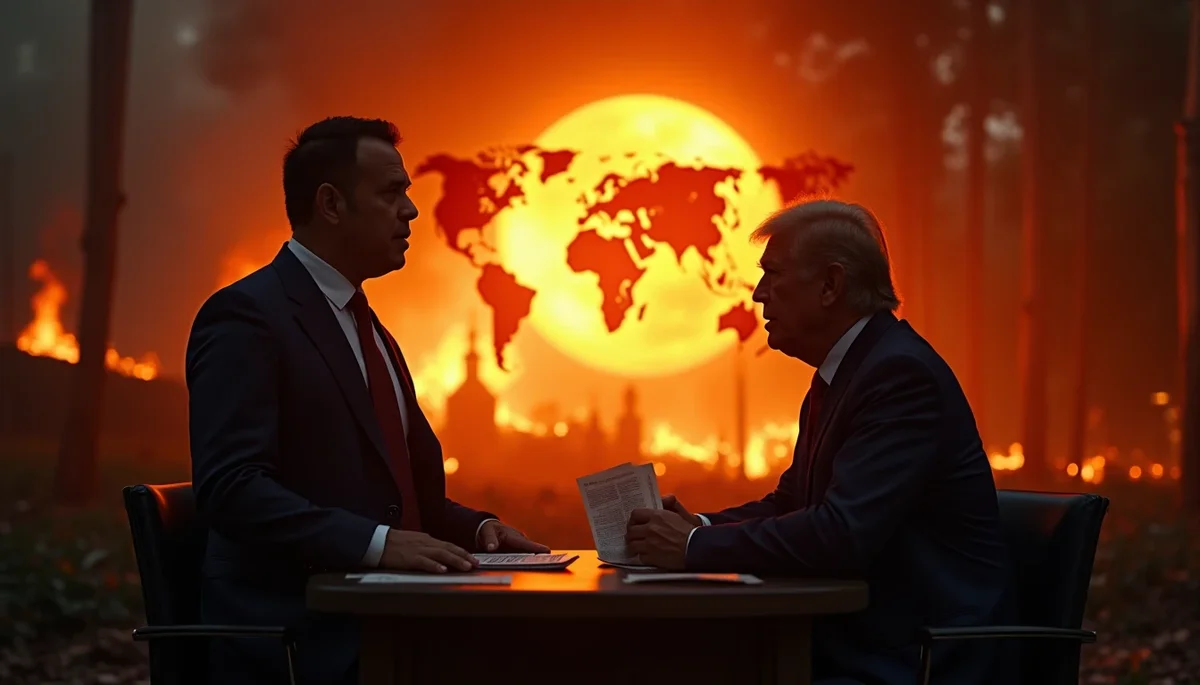
The predawn hours of January 3rd, 2026 witnessed a dramatic escalation in American foreign policy as U.S. forces launched what officials describe as a 'large-scale strike' against Venezuela, culminating in the capture of President Nicolás Maduro and his transport out of the South American nation. The operation, which left Caracas reeling from extensive infrastructure damage and widespread power outages, has sent shockwaves through the international community and drawn sharp condemnation from an axis of nations increasingly aligned against Western intervention.
Russia, Iran, and China issued coordinated statements denouncing what they termed 'flagrant armed aggression,' with Moscow offering to mediate the crisis. Iran and Hezbollah added their voices to the chorus of condemnation, while the European Union struck a more measured tone—acknowledging that Maduro 'lacks legitimacy' while calling for respect for international law. The capture of a sitting head of state through military force marks a significant departure from diplomatic norms, raising questions about the precedent being set for international relations in an increasingly multipolar world.
The Venezuela operation unfolds against a backdrop of persistent regional tensions. In the Middle East, the Iranian hacker group Handala claims to have breached the phone of Israel's former Justice Minister Ayelet Shaked, threatening to release sensitive data in coming days. Meanwhile, the IDF continues operations against Hezbollah targets in southern Lebanon, striking the village of Al-Khiyam, while reports emerge of settler violence wounding a Palestinian man in the West Bank. The interconnected nature of these conflicts—with Iran condemning American action in Caracas while simultaneously conducting cyber operations against Israeli officials—illustrates the complex web of proxy conflicts and information warfare that characterizes our current moment.
Gaza remains a humanitarian catastrophe as severe winter weather compounds the suffering of those displaced by ongoing military operations. Nine-year-old Assad al-Madhna, who lost his left hand to Israeli fire while playing with other children in al-Zuwayda, represents the countless wounded struggling to survive on scant humanitarian aid. The ancient prophet Zechariah spoke of a time when 'Jerusalem shall be inhabited as towns without walls'—a passage scholars have long associated with periods of siege and displacement. The current conditions, where hundreds of thousands seek shelter from both conflict and elements, echo the cyclical patterns of suffering that have marked this contested land throughout millennia.
Above our heads, the sun itself stirs with unusual activity. Solar observers captured a striking jet eruption in the sun's southeast quadrant early this morning, recorded at the 304-angstrom wavelength by the SUVI instrument aboard GOES-19. As Earth reaches perihelion—its closest approach to the sun in its annual orbit—monitoring services track potential coronal mass ejections that could impact communications and power infrastructure. The timing carries an almost poetic weight: as human systems of power project force across continents, the cosmic forces that dwarf all earthly authority continue their ancient cycles, indifferent to our conflicts.
In Brussels, the digital transformation of money advances through contentious political negotiations. The EU Council has backed the European Central Bank's digital euro design, but experts warn that achieving 'cash-like privacy' represents among the 'hardest political tradeoffs' facing policymakers. The tension between surveillance capabilities and financial privacy will shape whether digital currencies become tools of liberation or control—a question with profound implications as nations race to establish their monetary frameworks for the digital age.
Turkey's announcement of its first overseas deepwater drilling operation off Somalia signals the expanding reach of regional powers into strategic waterways, while China reaffirms its commitment to artificial intelligence dominance with new technical papers on large-scale AI training frameworks. These developments, seemingly disconnected from the day's headline violence, represent the quieter restructuring of global power that often proves more consequential than military operations.
What emerges from this day's events is a picture of accelerating fragmentation—of alliances, of norms, of the post-World War II international order. The prophet Daniel spoke of a final age when 'many shall run to and fro, and knowledge shall increase.' We witness both phenomena simultaneously: unprecedented mobility of military force and information, coupled with technological advancement that outpaces our wisdom to govern it. Those watching these developments would do well to note not just the headlines, but the deeper patterns of power consolidation and resistance that will shape the months ahead.