
The San Ramon Valley in Northern California experienced a jarring sequence of earthquakes early this morning, with a magnitude 4.0 tremor striking at 3:56 UTC followed by a 3.6 magnitude event just seven minutes earlier. Both quakes originated approximately 5 kilometers south-southeast of San Ramon at depths near 9.6 kilometers, generating over 3,000 combined 'Did You Feel It?' reports from rattled residents across the Bay Area. The seismic activity didn't stop there—additional tremors rippled through the region, including a magnitude 3.0 near Ojai in Southern California and a 2.8 near Lakeport, painting a picture of unusual restlessness along California's complex fault systems.
Simultaneously, our planet's relationship with the sun enters a more dynamic phase. Solar activity jumped to moderate levels over the past 24 hours as Active Region 4312, emerging from the sun's northeast limb, unleashed an M1.1 flare at 7:53 UTC on December 20. This follows another M-class flare earlier in the period, signaling that the sun remains firmly in its solar maximum phase. While these moderate flares pose no immediate threat to Earth's infrastructure, they serve as reminders that we orbit an increasingly active star—one capable of producing far more significant events that could impact satellite communications and power grids.
The timing proves particularly noteworthy as California braces for what meteorologists are calling a significant atmospheric river event. Multiple moisture-laden systems are forecast to impact the state between December 20 and 25, with the Sierra Nevada potentially receiving between 250 and 500 millimeters of precipitation—that's 10 to 20 inches of rain in less than a week. The strongest system, expected to peak December 23-25, will carry Integrated Vapor Transport values exceeding 750 kg m⁻¹ s⁻¹, placing it firmly in the AR3-AR4 intensity category. For a state still recovering from devastating wildfires, this atmospheric onslaught brings both relief and risk—potential flooding and mudslides in burn-scarred areas could prove catastrophic.
Meanwhile, the earth continues to rumble beyond California's borders. Russia's Kamchatka Peninsula hosts ongoing volcanic activity at both Bezymianny and Krasheninnikov volcanoes, with the latter maintaining an orange aviation alert level despite seismic monitoring being downgraded. Across the Pacific, Alaska registered a 3.9 magnitude quake near Unalaska, while global volcanic monitoring reports continued eruptions at Guatemala's Santiaguito, Pacaya, and Fuego volcanoes, along with Mexico's Popocatépetl and Indonesia's Soputan.
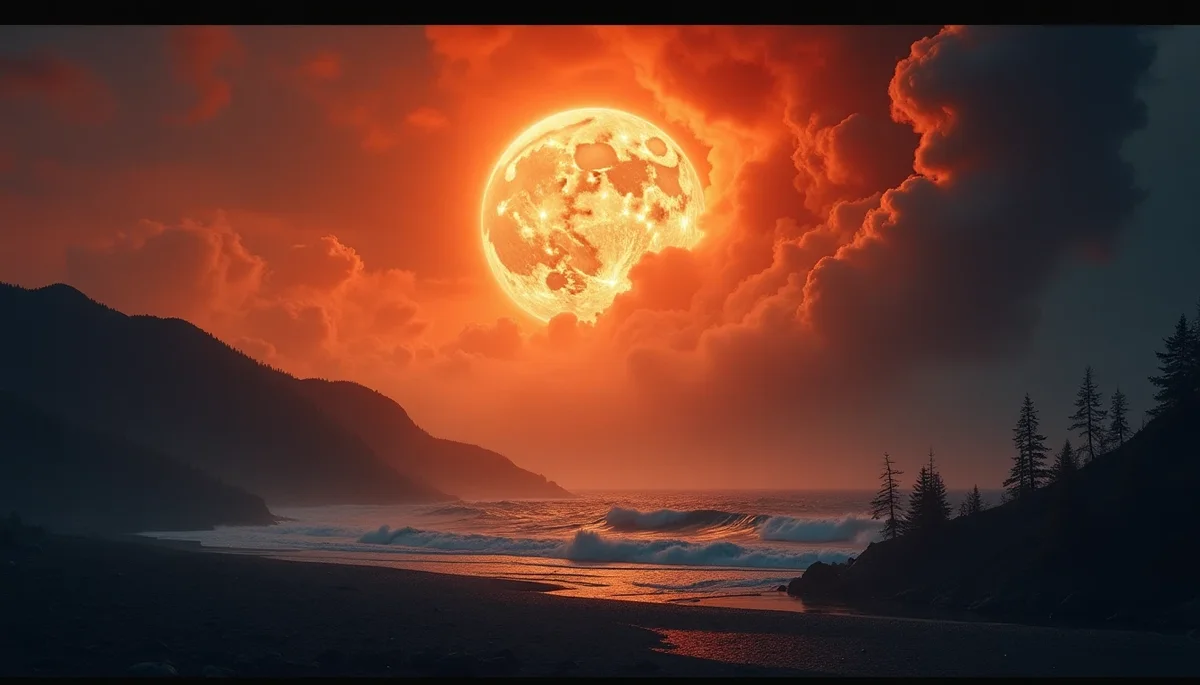
For those who study patterns in natural phenomena, the convergence of seismic swarms, solar intensification, and atmospheric extremes within a single news cycle invites reflection. The prophet Joel spoke of signs in the heavens and on earth—blood, fire, and columns of smoke. While modern science provides mechanical explanations for each phenomenon, the sheer clustering of events across multiple systems reminds observers that our planet remains a dynamic, interconnected system where stability is never guaranteed.
The coming days demand vigilance on multiple fronts. California residents should prepare for potential flooding while remaining alert to aftershock activity. Space weather forecasters will monitor Active Region 4312 as it rotates into a more Earth-facing position, where any significant flares could produce geomagnetic effects. And across the Pacific Ring of Fire, volcanic activity continues its ancient rhythm, largely unseen but never truly dormant. In an age of technological confidence, nature repeatedly demonstrates its capacity to humble and surprise.