
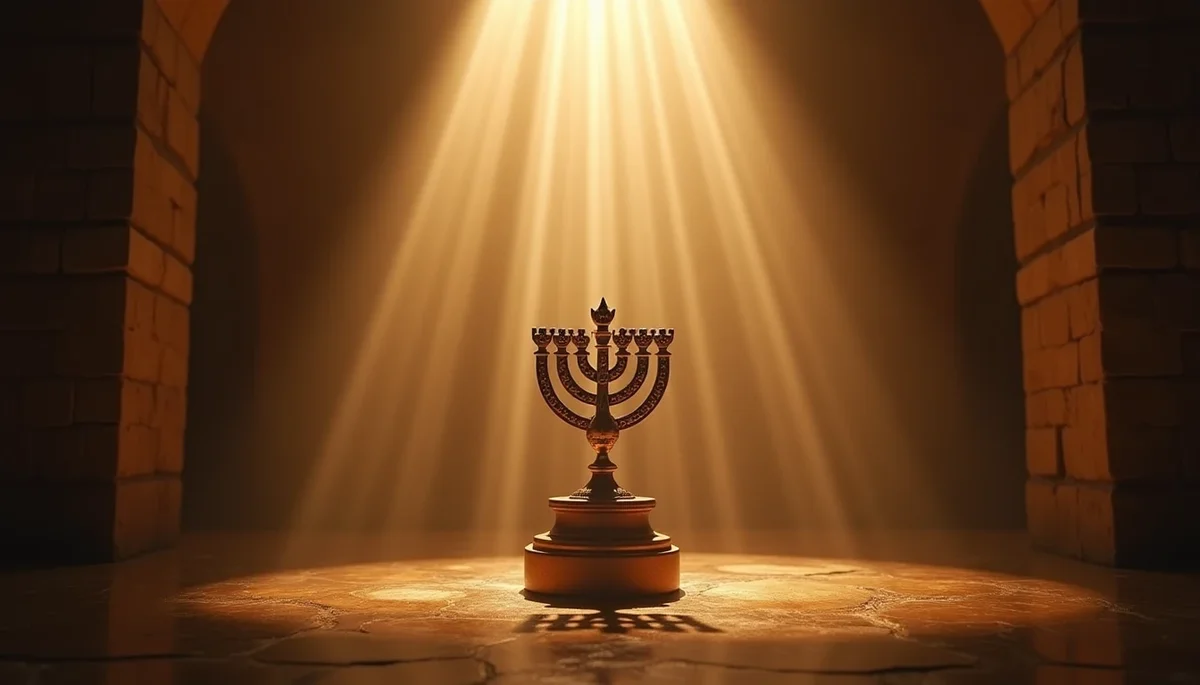
A 1,300-year-old lead pendant bearing the seven-branched menorah symbol has surfaced in excavations near the Temple Mount, raising profound questions about Jewish presence in Jerusalem during the Byzantine era when such presence was officially forbidden. The Israel Antiquities Authority announced the discovery Monday, noting the crudely fashioned amulet—possibly homemade—was found in a Late Byzantine building layer dating to approximately 700 CE. The find suggests either a Jewish visitor defied imperial restrictions or that Jewish traders maintained clandestine connections to their holiest city even under prohibition.
The timing of this archaeological revelation carries particular weight as three Palestinian families in the Batn al-Hawa neighborhood of Silwan in East Jerusalem were forcibly displaced from their homes Sunday, following Israeli court orders favoring settler organizations. The ancient pendant and modern displacement share a common geography—the slopes descending from the Temple Mount—where competing claims to Jerusalem's sacred ground continue to generate friction. For students of biblical prophecy, Jerusalem's contested status remains central to eschatological frameworks, with the prophet Zechariah declaring the city would become 'a cup of trembling' for surrounding peoples.
Meanwhile, the artificial intelligence industry faces what analysts are calling its great reckoning of 2025. A widely cited MIT study claiming 95% of organizations investing in generative AI are seeing 'zero return' has accelerated a reassessment of the technology's near-term potential. The AI doomers—researchers warning that artificial intelligence poses existential risks to humanity—find themselves in an awkward position: vindicated in their caution yet watching the immediate threat recede as the technology underperforms its most extravagant promises. Credit default swap activity for major US tech companies has surged 90% since September as investors hedge against the possibility that AI ventures financed with bonds may never deliver returns.
This technological humbling arrives as religious voices sound alarms about AI's spiritual implications. Writing in Harbingers Daily, commentator Jan Markell warns that artificial intelligence is 'paving the way for a robot Messiah,' echoing concerns that humanity's search for technological transcendence mirrors ancient patterns of idol-making. The convergence of AI disillusionment with religious critique suggests a broader cultural moment of questioning whether silicon can deliver salvation.
Geopolitical tensions continue to simmer as Israel and Hamas trade accusations over delays in the second phase of their US-brokered ceasefire. The killing of senior Hamas commander Raed Saad near Gaza City has inflamed Palestinian accusations of Israeli violations, while Israel claims Hamas refuses to hand over the remains of the last captive and is seeking to 'remilitarize.' Qatar and Turkey, meeting at the Doha Forum, are openly demanding changes to the Trump administration's Gaza plan that critics say would effectively hand the initiative to Hamas's longtime supporters.
Seismic activity continues its persistent global pattern, with a magnitude 5.5 earthquake striking 166 kilometers southeast of Petropavlovsk-Kamchatsky, Russia, early Monday. Additional tremors registered in Chile, Puerto Rico, Hawaii, and California's wine country, where a 4.0 magnitude event rattled Glen Ellen. The earth's restlessness provides a fitting backdrop to human upheaval—Jesus himself cited earthquakes in diverse places among the signs preceding history's culmination.
In a development with implications for religious liberty, Nicaragua has banned tourists from bringing Bibles into the country, adding scripture to a prohibited items list that includes drones and printed newspapers. President Daniel Ortega's regime continues its systematic suppression of religious institutions, a pattern watchers of prophetic trends recognize as consistent with end-times scenarios involving persecution of believers. As 2025 draws toward its close, the convergence of archaeological discovery, technological correction, geopolitical instability, and religious restriction presents a landscape demanding careful observation from those who take seriously the biblical mandate to discern the signs of the times.